Online Research
Witches in Cinema
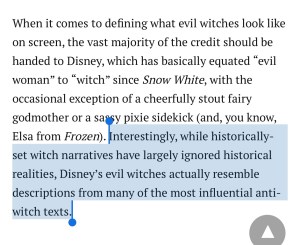
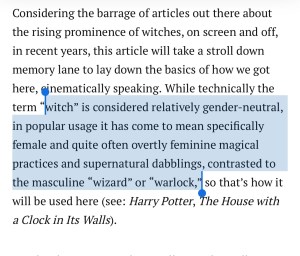
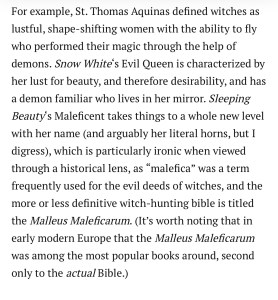
Overtime, witches have been portrayed in many different ways through cinema. From different looks to different intentions, it’s clear to see that there are more to witches than just the bad ones. Wardlow (2018) stated that the term “witch” is considered “relatively gender neutral”, however in popular usage it can come to mean specifically female and “often overtly feminine magical practices and supernatural dabblings, contrasted to the masculine “wizard” or “warlock””, this shows what movies and mainstream media has to done to witches
Over the years, a witches appearance has become more associated with being “ugly” rather than pretty, or beautiful. However it appears that Disney are the ones who began giving witches they disheveled appearance. Wardlow (2018) states that “Disney’s evil witches actually redeem me descriptions from many of the most influential anti-witch texts”. Therefore, this has obviously created a negative view of witches, but in fact, witches can be appear to be quite the opposite to what Disney paints them as.
For example, Wardlow touched on Snow Whites Evil Queen character, she always appeared to be beautiful, and desired, however in contrast, Disney’s Maleficent is quite the opposite to this, with her horns and overall evil nature.
This information is personally helpful to my project as I aiming to create a more realistic view of witches, rather than them being disheveled and “ugly”, I want to break the norms around this stereotype, by making the witch a somewhat normal character, who would resemble any other human.
Experimental Filmmaking
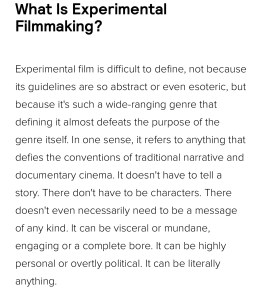
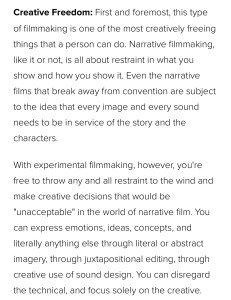
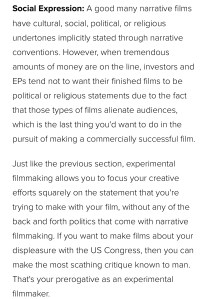
Hardy (2013) describes experimental filmmaking as being “hard to describe” but it “refers to anything that defies the conventions of cinema”. This basically means that when using experimental filmmaking, the rules of conventional cinema are being broke. With experimental filmmaking there does not have “to be a message”, it could be whatever the filmmakers are intending it to be which is which experimental filmmaking can be so confusing yet engaging
Experimental filmmaking should include “creative freedom”. There can often be a “restraint” with narrative filmmaking at Hardy suggests. However when it comes to being experimental, the all the rules of narrative filmmaking can be broken, as you are free to use whatever type of storyline, visuals or broken narrative that you want to, as this is how this visual style is carried out. Any “emotions, ideas, concepts” can be expressed through the “juxtapositional” editing.
Furthermore, it’s also about social expression. If there is anything, a message, possibly, that you want to convey, experimental filmmaking is ideal for this. Hardy stated that through narrative filmmaking does not allow you to express political, social, cultural or religious tones properly because of the “tremendous amount of money on the line”. So therefore, experimental filmmaking let’s you have the creative freedom, this can be done, without any of the “ back and forth politics that come with narrative filmmaking”.
This information was ideal for me to know as I want to use experimental filmmaking in this upcoming project. This is because I want to express the Wiccan religion though experimental filmmaking as I believe it will make the film appear more fun and captivating, in addition to me expressing the message to the audience.
The Wiccan Religion

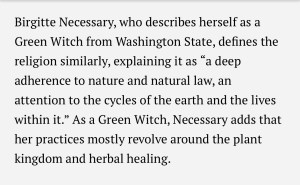
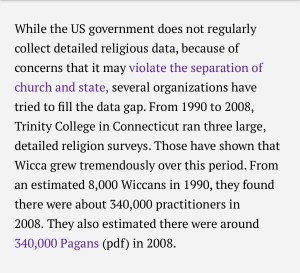
Singh Hurtz and Kopf indicate throughout this article that the Wiccan religion seems to be growing and becoming more popular. But they also touch on the misconceptions of the Wiccan religion. They state in the beginning of the article that Wicca includes “free though and will of the individual, and encourage leaning and an understanding of earth and nature.” This begins to show that this type of witchcraft uses more elements of nature to within their religion rather than anything else.
Furthermore, the pair also wrote about Brigette Necessary, who “describes herself as a Green Witch” which has a “feel adherence to nature and natural law, an attention to cycles of earth and the lives within in it”. This shows that if we are going to represent the Wiccan religion in our work, it is definitely important to consider this information regarding the use of nature, as nature might be one of our main props.
Singh-Hurtz and Kopf also bring up the fact that Wicca is growing “tremendously” and becoming more and more popular. From an estimated 8,000 Wiccans in 1990, it has been found that there was a jump to 340,000 practitioners in 2008. This shows that this religion is only getting more popular, which means that including elements of this in a short film would definitely raise a lot of attention to it.
REFERENCES
Wardlow, C, (2018). FILMSCHOOL REJECTS, A Short History of Witches Onscreen. Retrieved from
https://www.google.co.uk/amp/s/filmschoolrejects.com/witches-on-screen/%3famp
Hardy, R, (2013). nofilmschool, Experimental Filmmaking for Dummies (Part 1): Why You Should Be Making Experimental Films, Retrieved from https://nofilmschool.com/2013/11/experimental-filmmaking-for-dummies-part-1
Singh-Kurtz, S & Kopf, D, (2018). Quartzy, THE US WITCH POPULATION HAS SEEN AN ASTRONOMICAL RISE, Retrieved from https://www.google.co.uk/amp/s/qz.com/quartzy/1411909/the-explosive-growth-of-witches-wiccans-and-pagans-in-the-us/amp/

 Akira's Media Blog