Within this questionnaire, our group aimed to find out more about what people think of social media and how it influences others for our upcoming documentary.
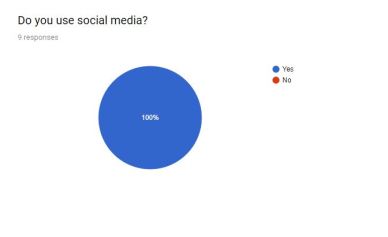
Firstly, within the first question, we wanted to know the rough estimate of people who use social media, and as it can clearly be seen, everyone who answered our questionnaire, used as least some form of social media, which therefore supports our statement that the majority of society uses social media. This means that our audience will be able to relate to our documentary.
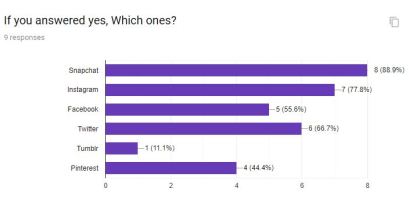
As it can be seen, Snapchat (88.9%) and Instagram (77.7%) are the most used social media platforms. Both of these platforms have something in common; the sharing of images. This shows how much image can influence an audience is this is what they look at for long enough. Another point to add to this is that this data also shows that everyone who answered this uses at least one of these apps. This will help with our documentary as it means that when it comes to planning interviews, the questions we ask will be comprehendible by the interviewees.
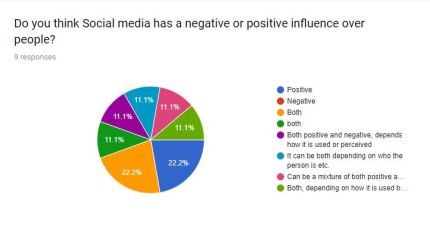
This question showed that the majority of respondents believed that social media is mainly positive/ or a mixture of positive and negative. Seeing as we want to put social media in a more positive light, this data will support our statements as we can question people on why they might think that social media is positive and how the pros might outweigh the cons.- which will achieve our obvious aim of making a biased documentary.
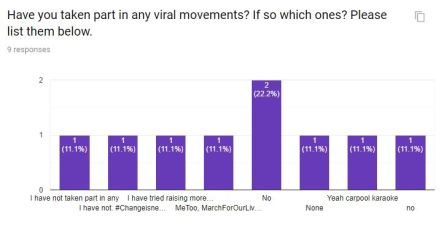
When asking the audience about them taking apart of viral movements, we made this an open answer question so that they specify, but it seems that this gave invalid data due to the fact that not a lot of the respondents did not give set answered. Although they may have misunderstood the question by assuming that this meant actually going out to protests. However, we wanted to know if they had shared anything online to do with any viral movements. Luckily, in other questions, we asked more specifically in regards to these topics.
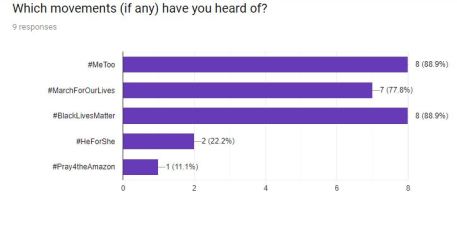
When asking the respondents about what movements they heard of, it was apparent they had heard of at least one of them. This reflects on social media’s power in regards to spreading awareness on extremely important issues, that might not be talked about enough in real life. These issues are will the key things that we want to cover in the documentary.
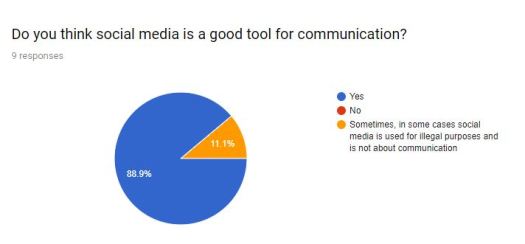
Another positive impact of social media is its use for communication. Especially when it comes to staying contact with your loved ones who live further away or meeting people online. The overall agreement that the audience with this statement was evident; with 89.9% saying ‘yes’ and no one saying no. Therefore, highlighting another benefit of using social media.
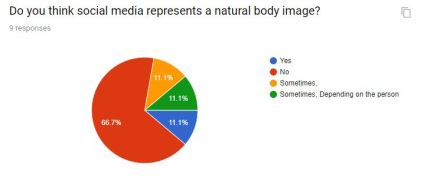
Now, moving onto the more negative aspects of social media, we started questioning the audience about body image on social media and if they think that what social media represents is real. As it can be clearly seen, 66.7% said no. This shows that it is known by the majority of society that images posted by models, news outlets, companies, etc. on these platforms, are not necessarily ‘real’. In our documentary, we want to know what people really think about this and how is makes them feel as individuals as this is another powerful effect that social media can have on people.
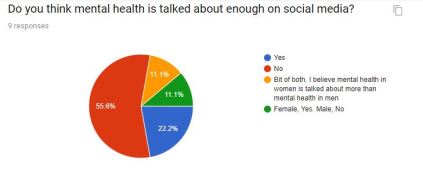
Mental health is another topic that might not be talked about enough on social media, and the respondents agree as 55.6% answered ‘no’. We want to cover sensitive topics like this in our documentary due to the fact that people should discuss mental health more, especially in men, which could also be linked to toxic masculinity. Therefore, interviewing boys/men in this issue could also bring out information on why social media could’ve helped/not helped with their mental health.
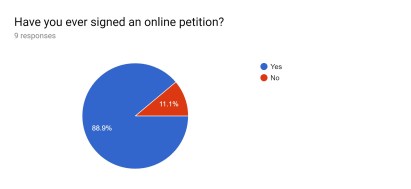
Online petitions are another big part of taking part in viral movements on social media and how these movements might reach out to people. Signing petitions can be as easy as entering your email and filling in your name on a form and you’re apart of the process for change. This is a way of taking part in something without having to go out of your way. And as it can be seen 88.9% of the respondents have actually taken apart in this. When creating our documentary, this would also be another interesting topic of discussion.
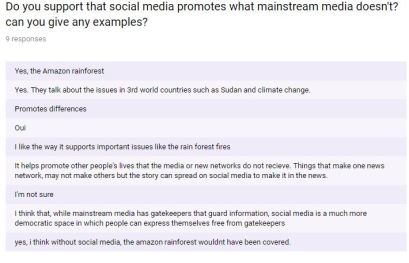
The answers from this question show that the majority support that social media is a more open and free space to discuss extremely important issues that the mainstream media did not or hardly covered. All of the respondents supported this, especially in regards to the Amazon Rainforest fires or climate change. Some suggested that social media is a more free, democratic place to spread information due to the fact that there are no gatekeepers that guard information.
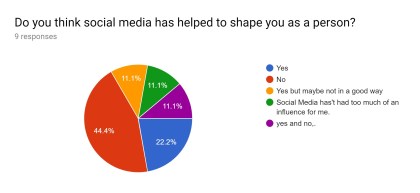
This was quite a broad question but the majority of respondents stated that social media has not influenced them as a person (44.4%), but 22.2% said that it has. This is an interesting topic to explore further in our documentary as social media can influence many people differently. It would be interesting to gather different viewpoints when discussing this topic.
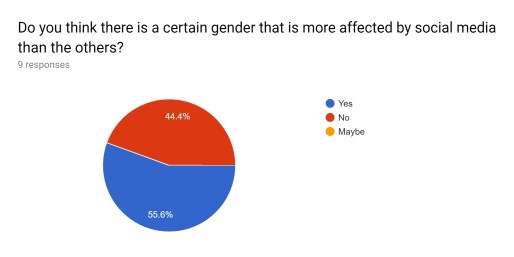
When we asked this question, the certain ‘gender’ we had in mind, would be women, due to most Instagram models being women, therefore making women/younger girls more conscious of their self-image. But of course, this would work in men’s case too, which is why the respondents answers are almost a 50/50 tie. This shows why we should also explore this topic further to see what both men and women think about this.
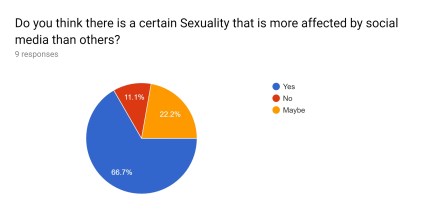
Asking a question about LGBTQ+ topics seemed important since social media has too, played a huge role in this community by bringing more people in the community together, in addition to people coming out and expressing their identities. The majority of respondents (66.7%) stated that asexuality IS more affected by social media than others. Because of this answer, this also proves to be an intriguing topic to discuss as this topic as whole, is another pointer in the direction of social media being positive. Would people rather use social media to promote change and better the world or would they rather stay off of it because it points out too many insecurities within themselves?

 Akira's Media Blog