Photography Evaluation: Coffee Table Book


Prior to this project, I completed research that would aid some of my ideas for what I would be doing. I researched into nature photography and the tips that other photographers were giving in order to take the right type of picture. I did a research fact file that helped me to do the whole project. I researched factors in photography such as the right type of ISO to use in certain types of lighting in addition to aperture and shutter speed. I also picked up tips such as not to disturb the nature around you while you are taking pictures, furthermore I discovered that landscape photography is the most common type of photography, therefore I wanted to include this yet take too many pictures in this style as I know that this is what people are used to seeing, therefore, I ensured that I used different photography styles such as portrait when taking pictures that people were in and using different angles to create a sense of individuality with each type of picture.

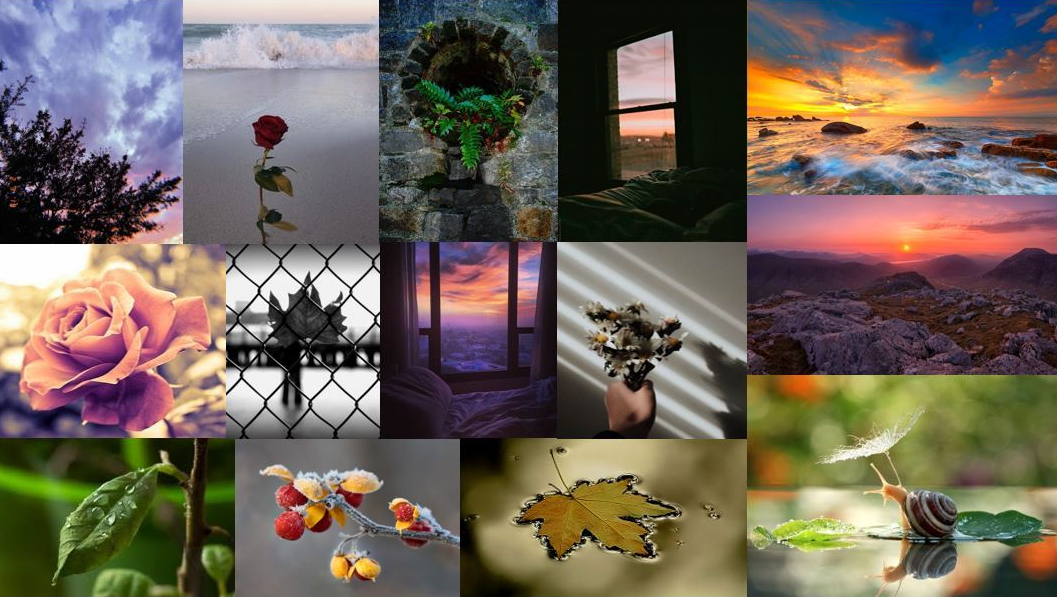
Within this project, I chose to do the theme of nature. However, I wanted to ensure that I was creative with the pictures I was taking, I did not just want to revolve my pictures around one type of nature photography, such as just focusing on landscape, close ups or one type of area such as a forest or a beach. I wanted to ensure that I could combine as many types of nature photography as I could in order to achieve the type of creativity I desired.

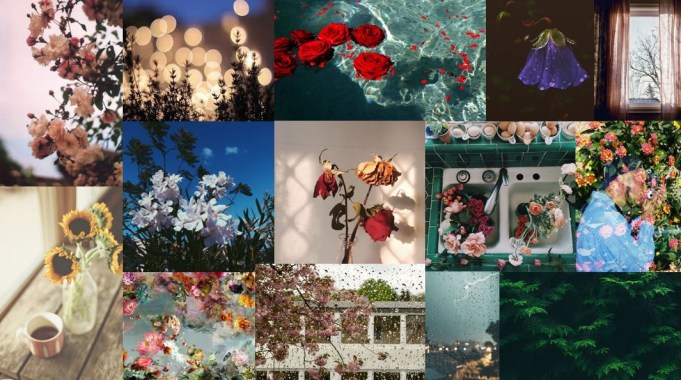
By making this project unique, I combined things such as ‘human nature’ which was using a model and getting them to pose with a bouquet of flowers. By doing this, I feel like I took a different turn on nature photography as I was combining human life as well. In retrospect, I see this as being effective to my work as I know now that it was a more unique option of portraying my work. I feel like these images are more interesting to look at instead of the average close up of flowers or landscapes.

When sticking to a theme such as nature for a photography project, it can be easy to assume that there is not necessarily a lot of ways to make the pictures creative or different to what you would normally see within this topic. However, by doing things such as using other people in your photos, or even just taking pictures of the ‘nature’ that is in the home, which is what I did as well. I took pictures of the house plants that we have, the flowers and even things such as crystals, etc. This still counts as nature; it is just not outside in the typical setting. This is another way in which I attempted to make my work just slightly more unique and intriguing.

Additionally, editing also plays a big role in how my images turned out. I applied editing to some pictures more than others. For example, I would just simply boost the saturation on some pictures to bring out the colours and then just added a simple filter over it to complete the image. However, for some, I tried to do more with them. For example, overlaying two images together. I never originally intended to do this but when editing I decided to try out new styles of presenting my images. There were two images that worked out the best together. I wanted to do this type of effect with more pictures, however, these are the only ones that I believed looked the best.


To further this, I tried to create a different theme for each ‘page’ of the coffee table book. I believe that this made this book more like a photographic story which made this more inviting for the audience to follow, in my opinion.

In regards to the way in which I took the photos, I experimented with many different settings to ensure that I could get different outcomes with my pictures. I did not just want to take the same type of pictures. I mainly used the manual mode so that I could adjust ISO, aperture and shutter speed to my own liking, as in some situations it was easier this way, for example, when it was darker or when I wanted to take some long exposure shots, which I tried doing often with sea water. However, I would have to say that long exposure is what I struggled with the most as I found it difficult to find a setting that would truly capture the exposure that I wanted.

I did not use a tripod for any of my pictures, but now in retrospect, I realized that for some of the pictures that I took would have been a lot easier to take if I had just used a tripod, for example, some subjects of the pictures would’ve been easier to position as I could’ve placed them slightly further away from the camera and got more of it in. Also, some images were slightly tilted which I had to fix while editing.

Another way in which I would improve this project would’ve been to visit more locations in order to get a more of a variety of pictures in regards to nature. However, to fix this issue, I still managed to use a sufficient amount of locations in order to avoid making all of the pictures look the same, but it would’ve added more to my work if I could have gotten pictures of wooded landscapes or even different types of plants and scenery.

Furthermore, when taking some of the pictures, I used some different lighting techniques in order to illuminate the subject of the picture and bring out the colours of it more. I also used the flash on the camera to aid the lighting of the locations I was in.

Peer Evaluation

I got a lot of good feedback of from my peers on my work, that gave me a better idea of what I did well and what I should improve. For example, one stated that I had a good variety of images and he thought they were all of a good quality. Someone else stated that they enjoyed the layout of my coffee table book and the themes that I applied to my images, additionally they stated that they liked my creativity of my work. However, they also stated that some of my pictures looked similar to one another, therefore I take this as them suggesting I use less pictures and focus more on the quality instead of quantity. Overall, a majority of my peers liked the quality of my table book and found the pictures interesting to look at.

Self-assessment:

Project Proposal

In regards to my project proposal, I gave myself a merit in this section as I believe that I had a good understanding and knew what I wanted to do with my project from the start of it. I stuck through with my ambitions and had a comprehensive understanding of the work that I wanted to do, and in the end, was overall happy with the work that I produced.

Research Folder

For the research folder, I gave myself a pass as I believe that I only gained the sufficient amount of research that I needed instead of going further and gathering more. However, I still gave the source of my data and the date it was found or the date that I found it if I couldn’t find the original date of the source. The reason for me not going further and getting more information was mainly because I gathered all of the research I believed that I needed in order to continue with this project. Furthermore, I also focused on other aspects such as the risk assessment, photographic, storyboard and the location reconnaissance.

The Finished Product

Concerning my finished product, I gave myself a distinction grade. This is because I put my full effort into getting all the pictures I wanted and needed in addition to making the table book as aesthetically pleasing and professional as possible. Each page, had its own theme, for example, I gathered images and labelled them titles such as ‘The Fairy Garden’ or ‘Twilight Zone’ and put them on the same page to create that particular theme. I wanted to make this seem more like a story so that it captivated the audience enough to want to look at the next page. Each page differed from one another which is what I think makes this book more unique. I think my work was imaginative, has aesthetic awareness and the flexible, processes, skills and knowledge applied in extensive enquiry to develop creative solutions.

The Evaluation

In regards to this evaluation, I decided to give myself a merit as I think I have given an effective communication of analysis of my work. I have been thorough and honest with my self-reflection and have given the strengths and weaknesses of the work that I produced and how I could improve. I also gave an insight to the process I went through to achieve the end product of my work.

Overall, I would give myself a merit on this work as I believe that I put in a lot of effort to get what I wanted. However, I do not think that it had enough variety in my pictures and editing in order to achieve a distinction, however I do think that I met all of the criteria for the merit grade and some of the criteria for distinction. Therefore, I am happy with this grade.


Coffee Table Book Production Diary-3

The Storyboard

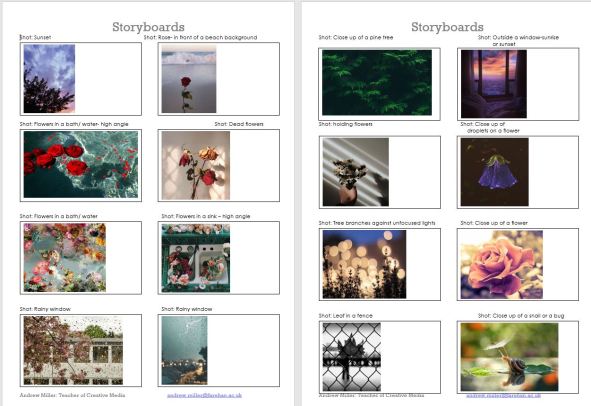
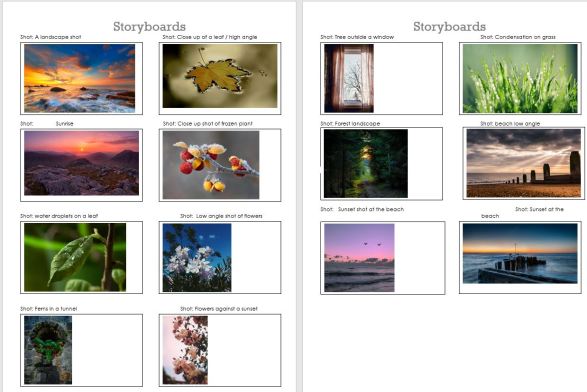
I completed a pictorial storyboard in regards to helping me create my coffee table book. It gave me the ideas for most of the pictures I took.

storyboardstoryboard 2

The Process of Taking and Editing Pictures

After I was done taking pictures, I ensured that I edited them on the same day that I took them as this means that I could go along with the rest of the process at a good pace, so that when it came to putting these pictures into the InDesign document, it wouldn’t take that long.

When it came to editing, I edited all of the pictures using the VSCO app. I used the many different filters to bring out the colours of my images. I also boosted the saturation and contrast and lowered the exposure to make my images more defined and to bring the colours out to portray my nature theme.

I also used the app PicsArt to add effects such as lens flares and to merge two images together to add more detail to my images.

Assistive Technologies


  • Assistive Lightroom– advanced editing tools including curves and colour mix tools. Selective editing healing tool and perspective correction. Get consistent looks by copying your favourite edits to an entire album of photos. Adobe Creative Cloud syncs edits between iPhone, iPad and the web. It captures RAW format images.

After using this particular app has been similar to working on Photoshop, except it is on your phone. It is useful for adjusting aspects of your pictures such as the vibrance, clarity, sharpening and more, you also adjust the colouring which helps bring the image to life. However, to make the app more effective, I think that filters should be added so that the photo’s editing process can be sped up as this app takes a while to use.


  • VSCO– Not only editing app, it also has and built-in camera with manual controls. These alter shutter speed, ISO and white balance.

This app serves more of an aesthetic purpose, in my opinion. When editing my own pictures, I go through the many already-made filters and choose one that I believe suits the picture the best, additionally, you can also adjust the exposure, contrast and even add tints or a grain to your photo. So it takes a while to find what you prefer, however in the end, you are left with a very aesthetically pleasing photo. I personally believe this editing app is the best out of all of the apps I have used because I think that is has more variety and I like the amount of filters that the app has to offer.

  • Miops– Connect your DSLR to simply techniques such as time-lapse, long exposure and other creative photography options.
  • When experimenting with this app, we plugged in a phone through a headphone jack to a camera, then we got someone to stand in front of the camera and scream to activate the camera, the sound of the scream will then make the camera take a picture. This app is particularly useful for when you are photographing things by yourself and want to take timer based pictures. It also gives more freedom and creativity to the photographer.
  • Snapspeed– It’s great for everyday photo editing, including exposure, colour, cropping and sharpening. It also has tools for advanced photo editing. These include curves, brushes and selective editing. And the healing tool removes unwanted subjects from photos.

I find this app very similar to other editing apps, therefore there is not anything that is particularly standing out to me, however, I do like the filter range, I think the editing tools can give a more cinematic look to your images. It also has more variety of editing tools.


Questionnaire Analysis- Coffee Table Book

Questionnaire Analysis- Coffee Table

1

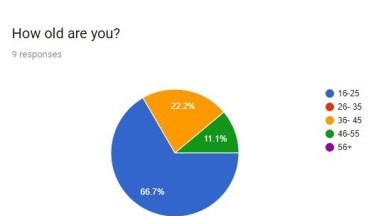
In my first question, I asked the audience how old they are to get a basic feel for the age range, and as the results show, the majority (66.7%) are 16-25 years old. I had no one above the age of 56 answering and the lowest percentage were 46-55 year old’s. This shows that, my main audience are in the younger category, therefore, I have to keep in mind that these are the majority of people answering my questions.2

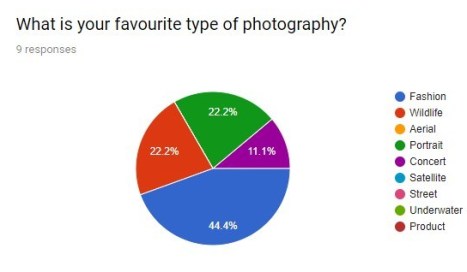
In this question, the overall results showed that fashion was the most favoured type of photography by getting 44.4%. However, in order for me to do this for my coffee table book, it may be difficult; even though I have access to a studio, finding the fashion and people to model the fashion will most likely not be easily accessible and if I did attempt this in my project, I do not think it would present my full potential in regards to photography as it would look too amature. Therefore, I need to choose between the two second choices that I have, either nature/ wildlife photography or portrait photography. To make my work it’s best standard, I think nature-based photography will be the easiest pictures to attain and it’s the type of photography that would look the best. 3

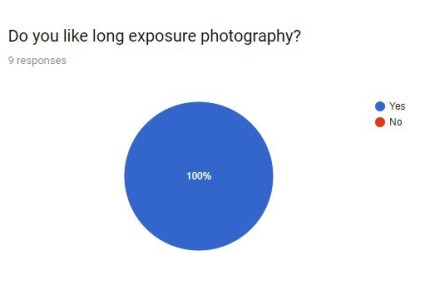
In this question, it showed that 100% of the people who answered, likes long exposure used in photography. Therefore, this is something to consider when doing my own work, I might include some long exposure and combine it in nature photography, if it is possible to link the two because this is clearly something that is aesthetically pleasing to people.


3

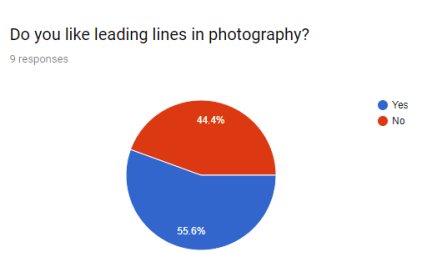
In this question, it showed that a fair amount of people like leading lines, as the majority voted yes (55.6%). However, the ‘No’ vote is not much lower than this as it is 44.4%, therefore leading lines is not necessarily something that I am going focus on, however there is a possibility that I will still include leading lines.4

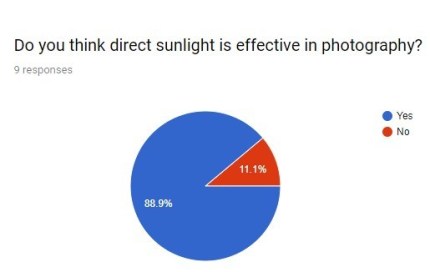
Direct sunlight in photography proves to be something that people like to see as the overall vote on this is 89.9% and only 11.1% voted no. therefore this is definitely something I will use in my project as it links up closely with nature anyway.6

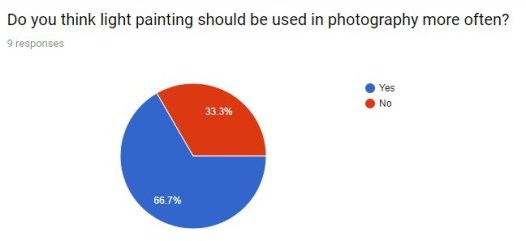
Light painting, is overall something people want to see being used in photography as the yes vote is 66.7%, however, 33.3% still said no which is about halfway under the winning vote. Therefore, light painting is not something I will focus on seeing as it does not really relate to nature, additionally long exposure is similar to this and that is something I intend to use.7

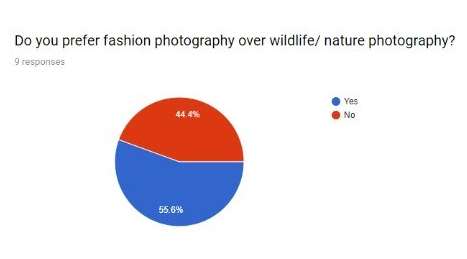
Fashion photography is more favoured (55.6%) over nature/wildlife photography (44.4%). However nature is not extremely lower than fashion therefore I am still motivated to use nature photography in my coffee table book as I know that people will still enjoy looking at these pictures.


8

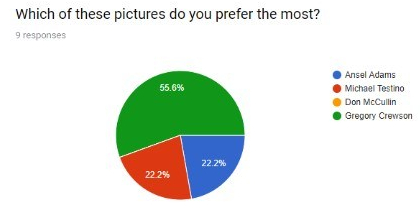
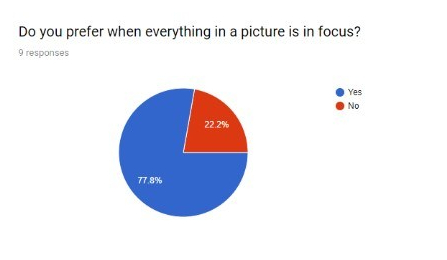
Gregory Crewson’s picture seemed to capture people’s attention the most (55.6), most likely because it was the only picture out of the photographers that was in colour, however Ansel Adams and Michael Testino, came in at second place (both getting 22.2%). However, Don McCullin got no votes, which means that war-based photography is not something people prefer. For my project, I will most likely try to combine Crewson’s and Adam’s style of photography by still using the nature landscape effect but using light and colour effectively to add more emotion to the pictures.1077.8% of people who answered this question prefer when everything in an image is in focus. Therefore, when conducting my own project, I will ensure that I use a narrow aperture to capture everything in the shot in focus. However, I might still experiment and take some wide angle picture mainly because I think that it will make the pictures more interesting instead of just using pictures of the same style.
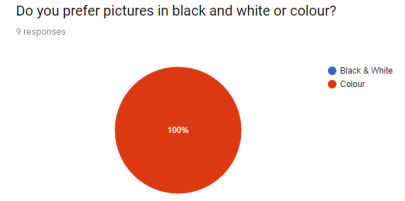
black and whitye

It can be clearly seen that no one likes seeing pictures in black and white, which is probably why Ansel Adam’s nature photography was not everyone’s favourite, however, if it was in colour, maybe people would have liked it more. Therefore, I will ensure when doing my own  project that all of my pictures are in colour.

11


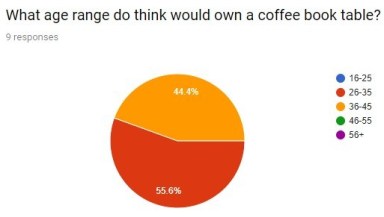
In this question, the majority of people who answered stated that overall, 26-35 year olds(55.6%)  and 35-45 year olds (44.4%) are more likely to own a coffee table book therefore, I need to aim my images at this age range, however, I think people of all ages will enjoy looking at nature-based images.

Photography Equipment

Types of camera’s:

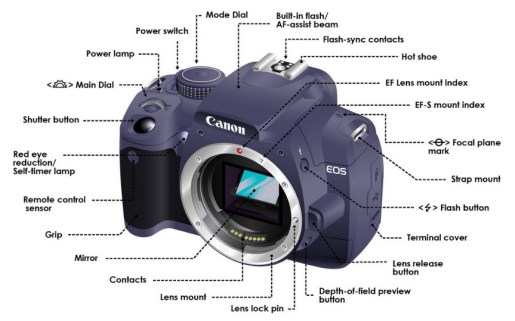
  • DSLR-Most efficient and will allow you to be more creative. It has adjustable ISO and aperture and built in flash. The lenses can come off and be replaced with different ones.
  • dslr
  • Analogue- No ISO or white balance. Rings to control aperture and used film which meant you had to develop them. The lens was not detachable. Also, it did not have an internet powered system. A motor was used to power it.analoyudegdyhuSLR- Shutter opens for a fraction of a second to emit light then the motor winds exposed film, the lens adjust to focus on the subject, the film reacts to light. It also has unexposed film.
  • DSLR- Shutter opens to emit light, light strikes sensor array, image data stored on RAM card and the lens adjust to focus on subject.
  • Lenses. 
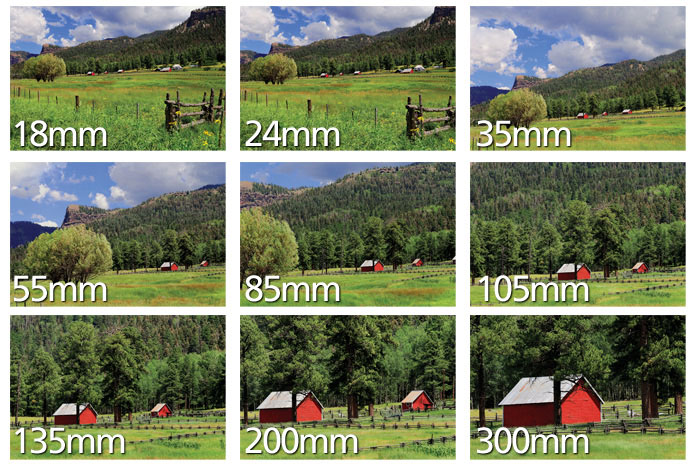
  • Image result for examples of different lens lengthsImage result for wide angle to telephoto diagram]#
  • Lenses can be taken off and replaced with different ones. 18mm-55mm is the typical kit lens on a camera.
  • Lens filters can be applied on your lens to get different effects on your photos. For example, a fish eye filter can make the picture slightly more distorted.
  • Personally, I would use the standard 18-55mm lens on a camera. For example, when trying to shoot a wide angle shot, I would use a 18mm lens and narrow aperture as it captures everything in view. However, if I am trying to shoot a close up- I would use a 55mm lens and a wide aperture.
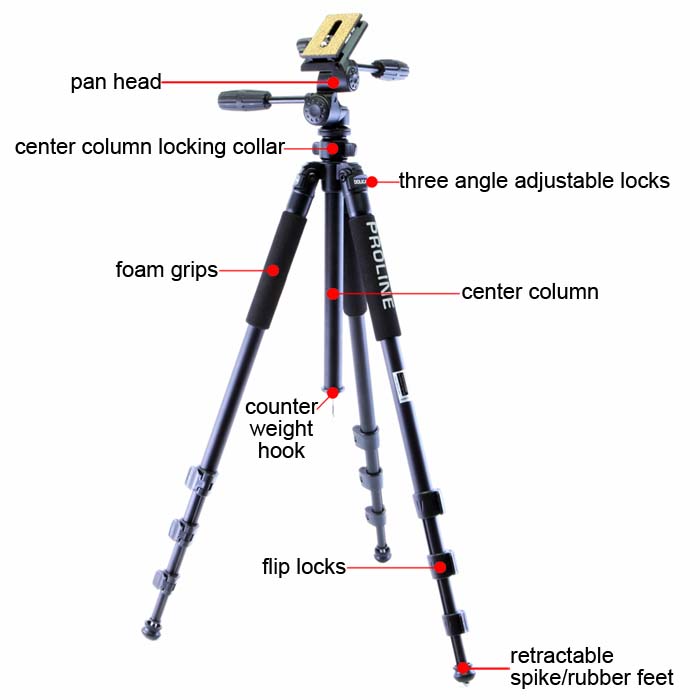
  • Tripods:Image result for tripod diagramUsed to lock- down a camera and gives it a good stable base in order to produce more stable pictures.
  • Additionally, you can tilt up and down and side to side without the image looking shaky.
  • Weighted tripods are more effective as it provides more security.
  • For example, I would tripods mainly when filming as I believe that the best footage is produced this way.  However, contrary to this, I don’t think tripods are needed are all times to get landscape pictures if you can already find a steady place to rest your camera.

Flash-

Flash can create nice silhouette. However, it should not be used at concerts or around people with epilepsy. Use a low speed flash if you want the background to be in shot too.

Flash in the best to use when highlighting a certain part of a picture. Therefore, I think that it is best to use it when taking portrait pictures as it highlights the face better. Sometimes flash can be useful in darker settings but only if the setup is right, otherwise the picture may look like it’s highlighting one subject too much.

Photography Challenge Day- Portsmouth- Top 5 Photos

Policeman

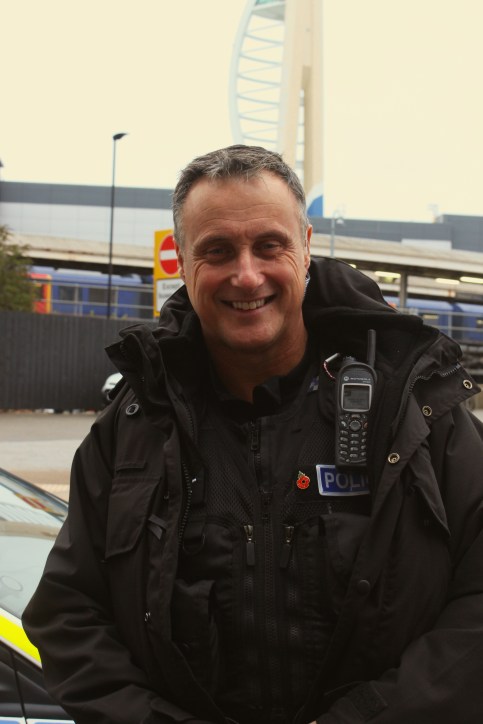
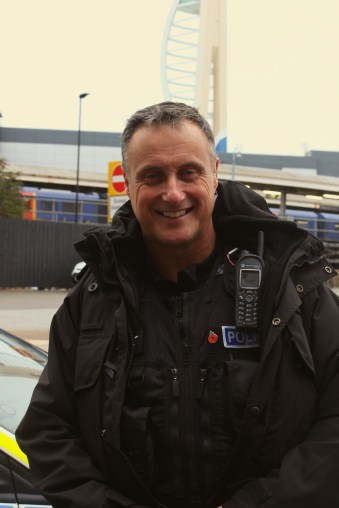
This is one of the first pictures that we got. Ironically, we thought that this would be one of the harder pictures to find as we did not know if any policeman would actually consent to having their photo taken. However, this particular policeman was very friendly and let us take his picture with problem. He also gave us the confidence to ask more people to get their picture.

Unconventional Fashion

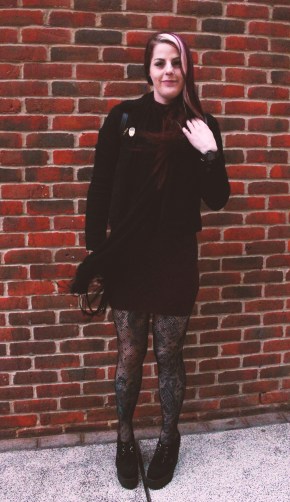
This is the picture that we used for unconventional fashion. This is one of my favourite pictures mainly because I liked her bold fashion choices so much. I also like the idea that she doesn’t feel the need to present herself the way that everyone in common society does.

Bird

I believe that this picture is very professional and realistic looking. When editing, I ensured to boost the vibrance and brightness to make the bold colours of the bird stand out.

City Landscape

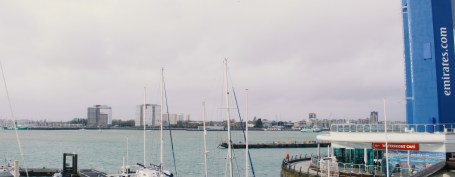
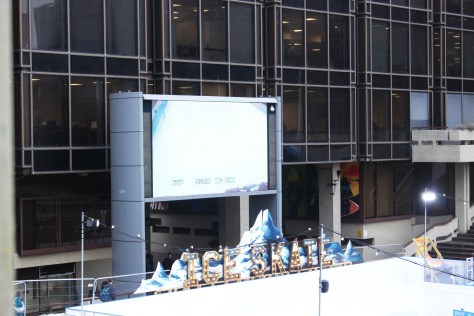
This is the picture that we used for a city landscape. A problem that I had with this picture is that it was a very overcast day, therefore it was hard to get a clear picture of the city. Additionally it would have been easier if we were closer to a city landscape as we couldn’t actually get a clear view of a city anywhere.

Glass Based Building

This is the picture we used for a glass building. What I don’t particularly like about this picture is that, once again, the overcast weather interfered with the lighting of the image and made it less clear.

Textual Analysis- Portsmouth Photography Challenge 28/11/18 – Policeman Portrait

Policeman

When assigned to do our photography challenge, one of the portraits we had to take was a portrait of a policeman. When first given this task, we thought that it would be a hard picture to achieve as we assumed that there were either going to be no policemen around or that most policemen would not want to consent to having their picture taken, especially if they were on duty, additionally, we just assumed that overall, policemen would be intimidating.

However, this picture was one of the first pictures we took on that day. We approached him while he was busy interviewing some workers in a Kebab shop and we waited for him outside until he was done, we then quickly asked if we could get a picture of him a college project. When he exited the shop he was holding a contained knife in a protective casing. Already at this point we thought that he did not want to be bothered. But, when we asked him, he was very much the opposite of what we were expecting. He was very friendly and welcoming and let us take his picture, he even made conversation with us by asking what type of camera we were using and informing us he also has a similar camera to the one that we were using.

This was very shocking to us based on our assumptions beforehand, this shows the problem with stereotyping before you really meet someone of a certain profession. In my opinion, this picture represents happiness and someone who is happy in their job. This picture definitely does not come off as intimidating and connotes that strong authoritative figures being are scary and intimidating is simply not true. They are just normal human beings living and working in society like everyone else, therefore, why should they be stripped of their personality? Their job is just a bit more complicated and gives them more authority over other citizens if they are breaking the law.

We took this picture as a portrait as it gives more personality to the shot. It shows who we are taking a picture of and almost what type of person they are. It seems that when people are talking about policemen, they focus on the fact that they find people and lock them up, however what people forget to mention is that policemen help us on a daily basis, without them, the country would be a very unsafe place. They help people get the justice they deserve and find the people who cause problems, misery and pain to a lot of families.

The stereotype surrounding policemen and just stereotypes in general can prove to be very unfair and all round unnecessary.

When editing this picture, I ensured that I brought out the warm tones, by firstly picking a filter that had autumn tones to it. I then adjusted the tint and made it orange; I think that this makes the picture more natural and inviting to the audience.

When people look at this picture, I hope for them to see someone beyond the police work uniform and someone who is naturally friendly and helpful, instead of making any stereotypical assumptions.