Within this Project Proposal, I speak of my initial thoughts and desires for my Final Major Project.
Book Research
Wiccan Religion-
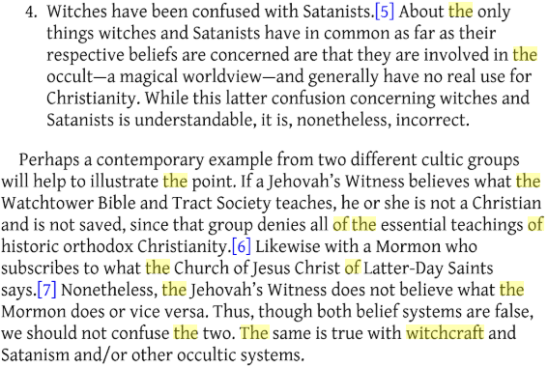
According to Hawkins (1996, np) witches have often confused witches with Satanists, the term ‘witch’ has been appropriated by the church and termed it as ‘medieval diabolical witchcraft’, showing that it has always been viewed as something negative. Hawkins also stated that the only relation between witchcraft and Satanism, is that they are both involved in an occult which is a magical worldview and generally have real use of Christianity. This shows that there can be a negative correlation between witchcraft and the real world. For example, this can be seen in multiple movies such as Witches or Hocus Pocus. Therefore, we aim to get rid of this stereotype and portray Wicca in a more realistic and positive light.
Females in Filmmaking-
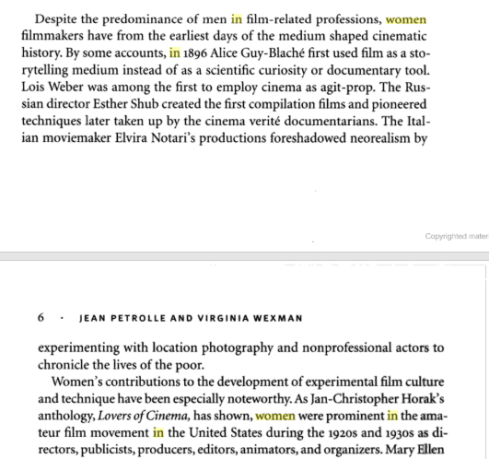
According to Petrolle and Wexman (2005, p.5) women have been around since the earliest days of the medium shaped cinematic history. Women’s contributions to filmmaking has been especially noteworthy, they were prominent in the United States during the 1920s and 1930s as directors, publicists, producers, editors, animators and organizers, (p.6). This information is useful due to the fact that it shows how relevant women and girls are in cinema and some of the most prominent films in cinematic history wouldn’t be available if it were not for the women behind them. Not only are our group just females but we want to explore with female empowerment in our film.
Horror in Film- Why do people enjoy horror in film?
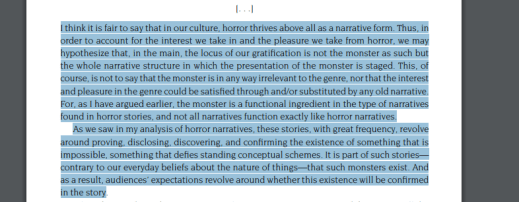
This information is valuable because it shows the true reasons behind why people enjoy horror, the narrative is key in these types of films, according to Carrol, N (2003, p.34) the monster is just a functional ingredient, it’s the story behind this that makes the concept interesting, which is what I need to remember when it comes to creating the narrative of our short film- that the storyline is the key element to what I am making.
Reference List
- Hawkins, C (1996) Witchcraft: Exploring the World of Wicca. Grand Rapids. Michigan
- Petrolle, J & Wexman.W. V (2005) Women and Experimental Filmmaking. the Board of Trustees, University of Illinois
- Carroll, N. (2003). The philosophy of horror: Or, paradoxes of the heart. Routledge.
Target Setting
These are the targets I need to achieve within the next two weeks. Firstly, I need to complete two textual analyses of two media products, one that will be set for me and one of my own choice. Within these analysis’s, I need to focus on MACRO and MICRO elements, which I will attempt to complete on 13/04. I need to focus on internet research in order to gather all of the information for my work. I also need to complete my blog post on the interview our class conducted with two former college students who gave us advice on our FMPs which I will complete today, 5/04.
Another piece of work I need to complete is my questionnaire analysis which I will complete next week, 11/04.
After I complete all of this, I will write a post on what I have to do next.
Field Experiment
Today I am aiming to experiment with abstract camera angles such as worms eye view and birds eye, which are both angles I have not used in my work before. This is because I want to practice and get an idea of what it is like to film from these angles as it is important for my group and I to know what specific positions the camera needs to be in, in order to achieve the angles. Also, I want to experiment with the green screen in the studio to see what it would actually look like if we were to use it in the FMP. This is to ensure that it will come out the way I expect, instead of it looking tacky.
I will carry out these experiments in the studio by using the green screen that is already on site. To ensure I am carrying out these techniques correctly, I will ask for assistance from the technician, so that when it comes to editing this footage, I will know how to make look as professional as I can. In regards to the camera angles, I aim to film a subject from different perspectives to see what these look like.
We do not aim use a specific tutorial, we will mainly ask our technician for help so that we can clarify everything there and then. If there is something that the technician is unclear on, then we will research further into it through watching tutorials.
The Green Screen:
The Practical Process-
Firstly, we headed to the studio and decided that we wanted to test out the green screen. We collected a camera, tripod and an SD card. We ensured to ask the technician to help us set up the lighting properly in order to get the full effect of the green screen. He told us to ensure that we set up the lights around the subject so that their shadow could not be seen at all, as this does not portray the reality of using a green screen if the shadow is seen.
I personally had the idea of creating a ‘dream world’, as we have the idea of using abstract and supernatural elements within our FMP. Therefore, I did not want to use it for realistic purposes, but in fact the opposite, therefore this was not something I was worried about. However, we carried on with this experiment and ensured that everything was done in the right order anyway.
We used a member of our group as the subject and we directed her to stand within the middle of the set that we created. We then just asked her to carry out simple actions, such as, jumping up and down so that it looks like she is falling, or even just standing still, so that we could experiment the best that we could.
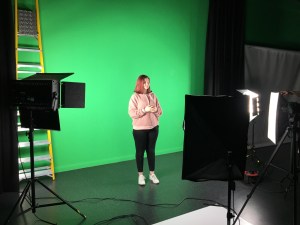
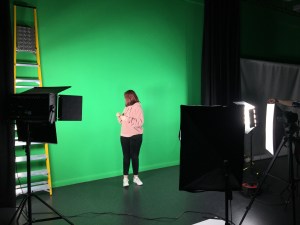
In regards to the lighting, we used high-key lighting at the front and low-key lighting on either side of the camera to illuminate her shadow.
The Editing Process
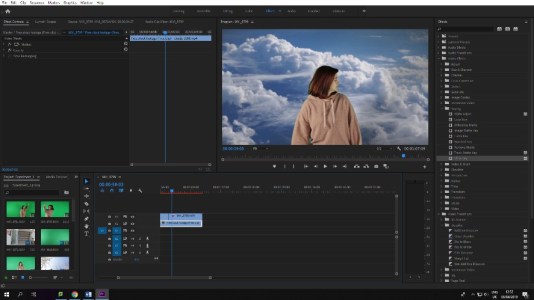
When editing the footage of the green screen, we simply downloaded footage of clouds and used as the main background for the green screen, just so that we could get a rough idea of what using the green screen would be like.
The editing process of this appeared to be surprisingly easy as all that needs to be done is to import the background to replace the green screen, import the main video of the subject, then proceed to go to video effects, click the ‘keying’ tab and choose ‘ultra keying’, then use the drop tool and click the green on the video, this will then make the video transparent and it will just be the subject in front of the desired background.
Evaluation of the Green Screen
After editing the green screen footage, it came out quite successfully, however I do not know if I still plan to use it in the FMP as I do not think it will be necessary. I noticed that it was difficult to completely block out the subjects shadow and it ended up showing on the screen while editing, meaning that it did not look completely professional. Therefore, I think it would be better if we just exclude the green screen from the FMP as this would not reflect what we truly want to do with our work.
Testing out Different Camera Angles
After shooting with the green screen, we decided to experiment with some different camera angles. Originally we were only aiming to experiment with worms and birds eye view, but we ended up doing a few more. We decided to get some shots outside as we don’t plan on filming in the studio that often for the FMP anyway, therefore we wanted to remain realistic with how we will be filming scenes for the FMP.
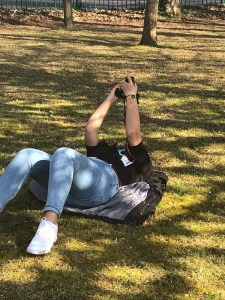
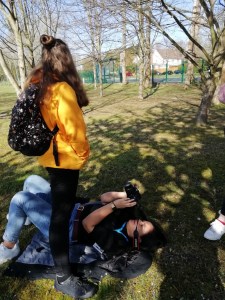
When we went outside, worms eye was the first shot we focussed on getting. To fully get a worms eye shot, I laid on my back and held the camera upright, which was the best way to achieve this. This was not the only way I took these pictures, as I also aimed to take some tilted worms eye shots too. I believe that these shots came out quite well and I could see the uniqueness of this shot, which is something I definitely aim to do.
When doing the birds eye view, we took a shot of the subject walking down the stairs. This was a quick shot which wasn’t hard to do, however, that was only in that specific scenario, without a drone, birds eye view is very hard to obtain when in normal surroundings with no higher platform to capture the shots. Therefore, if there is an opportunity to use birds eye view, I would take it, but only in more accessible areas where creating a birds eye view is possible.
The next shot we obtained was a Dutch tilt. We created this by getting a subject to walk outside of a fence, the fence being in front of the shot. This definitely came out the way that we were expecting, which is a positive as this is an angle we want to use in our project, seeing as we want our genre/theme to make people feel unsettled.
Another shot we tried using was a POV, handheld shot, which was something we were not planning on doing, however after doing, we are seriously considering using for our FMP, as we have come up with an idea so make some scenes in the project have handheld footage. This creates something unsettling and unknown to the viewer which it’s important to use.
The Editing Process
Editing these clips together gave me an idea of what it would be like to edit these types of shots for our FMP and I think editing can be a lot more smoother and easier if there are a variety of shots that can be edited from.
In each clip, I labelled each one so that anyone viewing will know which type of of shot it is. 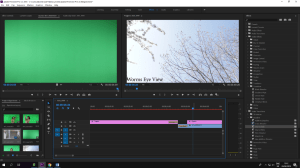
In regards to the colour grading, I mainly boosted the vibrancy, saturation and the sharpen, as this made our footage more aesthetically pleasing and it brought out the colours in the shots. 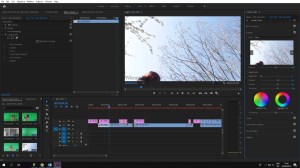 When adjusting the curves, I lowered the white level, as most of our scenes were quite bright, so by doing this, it once again brings out other colours in the scenes more effectively.
Evaluation of different camera angles:
I believe that experimenting with the different angles and shots today and definitely helped my group and I understand that a variety and angles will give us a better chance to keep the audience intrigued in our project. Furthermore, some of these shots are quite easily attainable yet they can have the biggest effect on the viewers, which is important.
Final Major Project Questionnaire
Within this questionnaire, I am inquiring to find out what people would find interesting to vie in short films. Such as genres, themes, visuals styles, the age and gender of people watching short films, viewing platforms of the short film, the lengths of the short film, etc.
This is to help me generate more ideas for my final major project.
https://docs.google.com/forms/d/e/1FAIpQLSd6pHT9EaoQkDTXRUQ6eCqkILb4mOF6nWfLmykiOM_uctA2bQ/viewform
7 Deadly Sins of Filmmaking
- Don’t Shoot Everything
Capturing too much footage can be a pro and a cons, however the strengths can be a weakness because shooting too much footage leads the filmmakers not thinking very deeply about what they’re shooting, because they are capturing everything unnecessarily. Therefore, it is important to plan your shots ahead of time and think effectively about what you want to communicate to the audience through your images.
- Take Your Time
Whenever getting a shot of some action and thinking that you have attained a suitable amount of footage, therefore you stop recording, it is important to keep rolling for at least another 10/20/30 seconds, as it will make things a lot easier when it comes to editing. Otherwise, you will regret editing a cut that needed to be recorded for just that few seconds longer.
- Leave Headroom
Headroom is the space between the top of the frame and the top of the subject’s head. Having either too much or too little headroom will create an unbalanced composition, if there is too much it can cause the audience to feel unsettles or uneasy with a floating head aesthetic whereas too little can cause them to feel claustrophobic.
- Don’t Over-Expose or Under-Expose
When filming outside, it is important to have additional lighting to put in front of the subjects and not use the sun as a backlight. Either the sky will be blown out or underexposing the subjects. If you do have lights, set them up in front of your subject so that there is a balanced exposure, if this is not possible, use the sun as the key light instead of the opposite.
- Don’t Overdo the Zoom
Constant zooming in and out will it difficult for the audience to know what they’re exactly supposed to be looking at. If this is what you intend to do, do a nicely composed push and pull focus.
- Mix Up the Angles
It’s always effective to attain a different perspective, especially when it comes to filming. Things are always being seen at eye-level therefore seeing this same type of shot can become boring. So, this can be fixed by shooting different angles, getting onto the ground (worm eye shots) or getting onto a ladder to get come high angle shots will be a great variation.
- Stabilise for Smooth Footage
Stabilisers can help transform a shaky, footage into a professional piece of digital art. It makes the footage easier to watch and it will most likely make your footage look better. If you don’t have access to stabilisers, there are other ways to stabilise your camera, you could use a heavy tripod, snorricams, steadicams and generally avoiding handheld footage.
Re-cap of Narrative
Re- Cap of Narrative
Story– tells a sequence of events. It is A, B, C and D, the set of relevant events that holds importance to others. They can be found in everyday life occurrences.
Plot– It describes sets of events as they relate to each other. It is concerned with selecting the events for its telling and the approach to that telling for max effect.
Narrative– It deals with how the events are told. The ordering of events into consumable format. It is their creativity shaping the entire project, making it significant to a specific audience.
- The styling/congruence.
Elements of narrative
- String of events occurring in space and time.
- Connected by the logic of cause and event.
- Psychologically motivated actions.
- Ties together character traits, goals, obstacles.
- It gives congruence.
Narrative forms
- Linear– chronological, most common, simple and organised, avoids flashback and dreams, predictable/archetypical (most original sense of the problem), genre: children, factual, children, classic
- Single strand– 1 set story-line, focuses on 1 person/ hero and their story, no groups/ teams, secondary characters allowed
- Nonlinear– no specific order/ fractured/ altered, intensified/ create a sense of instability, whole truth is unknown, no chronological order/less linear, back and forth in time and or characters POV.
- Multi strand– several story-lines, diff types of people, story focuses on each character’s individuals propose to the moral, goof for sequels, series, documentaries.
Framed Story lines– story within another, tale narrated by hero to other characters, audience might forget the initial story, genre: fantasy, fantastic drama, awareness, children, factual.
Circular- stories that end where they begin, hero returns home, denote np change (some stories), climax is the evolution/ end of adventure, genre: epic, fantasy, mythological
Theorists-
- Aristotle’s- Dramatic Arc- 3 act narrative
Todorov– equilibrium– all is in order, normal life is carried out:
- Disruption- of ordered state by an event
- Recognition- that the disruption has taken place- conflict
- Restoration- attempt to solve the conflict
- New equilibrium- different from where the story began
PROPP– e.g. Harry Potter – Protagonist/ hero
- Antagonist/ villain
- Helper/ friend
- Donor/support
- Dispatcher/directs
- False hero/ traitor
- False villain/ martyr
- Prince (princess)/ award
- Father/ awarding
Vogler-Campbell– Hero’s Journey
- Ordinary world
- The call to adventure
- Refusal of the call
- Meeting with the mentor
- Crossing the threshold
- Tests, allies and enemies
- Approach
- Ordeal
- Road back
- Resurrection
- Return with the elixir
Levi-Strauss
Oppositions can be visual or conceptual
- Love/hate
- Good/evil
- Light/ darkness
- Movement/ stillness
- Control/ panic
- Beauty/ ugliness
- Law abiding/ criminal
- Freedom/ imprisonment
Harmon- Story Cycles:
- Character is in comfort zone
- But they want something
- They have to enter unfamiliar situation
- They adapt to it
- They get what was wanted
- Heavy price to pay
- Return to their familiar situation
- The character has forever changed
Types of Narrative:
Realist– real life situation, audience relates, avoid boring/ repetitive, creativity limited, story has the most weight, speciality: dramas, audience knows as much as characters, they both learn together.
Anti Realist– set in non-realistic atmosphere, audience is presented with an alternative world, purely entertaining or awareness, heavily in imagination, chroma key, CGB and editing tools, speciality: fantasy, sci-fi, comedy.
Flashback– shows the past time, historical fiction, gives a purpose, shortens between events, explains/makes clear.
Dramatic Irony– audiences knows something that the characters do not, flanked by scenes in which audience learns something, sequenced by scenes in which characters finally learn what the audience has known.
Endings-
Cliffhanger- to be continued, intends to conceive a new story, last fragmented- high intensify occurrence, increase excitement about final product, intends to get further sponsorship, create interest in the follow up, genre: crime, drama, fantasy.
Open Ended- uncertain whether the hero achieved the goal or not, character has shown evolution, audience decides final fortune, used in two-part stories, genre:action,
Close Ended- traditional wrap-up, new equilibrium reached, everything has bee figured out, hero reaches goals, conflicts are sorted, genre: crime, fantasy and comedy, for example, Rocky.
Prophetic- leaded open ending, more certain, similar to cliffhanger (emotionally) but showing last scene that doom/fortune occurred during story might happen, genre: thriller, horror, comedy.
Reel Talk- Evaluation
Throughout the production of Reel Talk, there was a great deal of planning and idea generating to get an idea that we were actually confident to go through with. After a while of thinking what our show could be, we decided on it being based around Film and TV as this is what we found to be more interesting
There were many pros throughout this project. Firstly, as my role of production manager, I feel that I was effective by getting our group to communicate to generate their thoughts on what we should include in our show. By setting a ‘WhatsApp’ group chat, we managed to talk to each other easily which got thing done sooner. This chat helped with not only pre-production, but during production too because while some crew members were in the studio planning and wanted other crew members to see it, they would just post a message in our chat, proving it be extremely helpful.
Overall, the class or the “crew” worked very effectively together as we all stuck to our roles and getting specific things done with those roles. For example, the camera operators all stuck to creating shot lists and floor plans, the set designers created mood-boards and floor plans of the studio to show where all the props will go, the lighting crew were in the studio often, experimenting with different lighting tones and colours and they reported back to all of us often, and so on. Personally, I stuck to the pre-production such as the risk assessment and location reconnaissance whereas the floor manager of the show, who I worked closely with throughout the project, created the call sheet and production schedule. By working like this, we had pre-production work done sooner than expected.
However there were times during the planning stage that some ideas got changed around and in the end, there were quite a few aspects of the show that was different to the original plot we had planned. For example we struggled coming with ideas for the VTs and plans changed a lot for those. For example, our VT titled, In The Spotlight, was originally going to be based on three Mexican directors, for this VT, we were going to film one of our teachers reading information about them and use her voiceover over a montage of their clips from the movies, pictures of them, etc. However we decided to change this over completely to an interview with a Film and Television lecturer from Solent University about the impact of streaming platforms and services on broadcasted television. I was in the group to create this VT and we had to write approximately 10 questions for him to answer. Overall, this VT proved being a lot more effective than the previous one that was going to be filmed due it being easier and it seemed very professional in addition to it suiting our show more. Another VT we struggled with was the Reel List, which was originally going to have a presenter counting down the best movies and TV shows, however we recorded this whole segment and found out that the audio was not working, therefore we just decided to re-record the audio and just use a voiceover and compile videos and images and create a montage with a voiceover. However, luckily these changes were for the best instead of the opposite as it all worked out smoothly.
Another issue that I would’ve wanted to change would be getting the script to the hosts sooner, as we only got it to them 2 days before the show instead of getting it to them at least 4 days before. Despite our hosts being very compatible in addition to them comprehending the idea of the show, they did read a lot from the script on the day of filming, meaning that it looked somewhat unprofessional, however it was best for them to know what to say instead of them getting lines wrong or forgetting what they have to say, etc.
However, overall, the production of Reel Talk went very well due to the fact that everyone carried out their roles on the day making the day a great deal less stressful due to the fact that we all stuck to our own roles, however we still helped each other where need be, making the show a success
In regards to my own work, I believe that I stuck to my role well, I mainly focussed on the logistics on the show and ensured that everything came together the way we wanted/ planned. I did my job by sourcing the props we needed, getting the crew together, meeting the hosts and explaining to them what the show is going to be set on, working on the pre-production, directing a VT and overall ensuring the show was going to according to plan. However I do think I could’ve been more effective when filming but the floor manager had everything going to plan.
My peers stated that they thought I was effective as a production manager and fulfilled my role by being organised and ready to fix any issues that we had.
Social Media Updates
Throughout the production of Reel Talk, all the crew ensured to update our social media accounts everyday. We would alternate days when a group of us would post and keep the audience entertained and intrigued.
First week of production: On Instagram, we mainly put a lot on our “stories” in order to keep everything updated. For example we would put behind the scenes pictures of set design or the filming of some VTs in the studio in addition to things such as our pre-production work. We also used polls on our stories to ask the audience questions such as what shows the prefer, if they prefer one show to another. To keep them feeling excited, we created a countdown that we used everyday. Our Twitter consisted of very similar content. On this we also would tweet updates about our show and behind the scenes pictures.
Second week of production: In the second week of production, we still stuck to a strict schedule as to who was posting what and we ensured to keep updated as this week was the major week when most of the planning was occurring and everything was being finalised. For example, a lot of people went out to film their VTs including myself and a small group who went to Solent University to interview a lecturer. Therefore the next day while we were editing footage, I took a picture of it and put it on our story to show our audiences where we had been. Furthermore, throughout the week we just kept posting our countdown and sneak peaks/ behind the scenes posts to showcase our pre-production process. On the day of production, we still updated our social media by posting the preparation, the hosts getting ready in hair and makeup, and then finally the hosts on set. After we finished filming, we posted on our social media’s that we had wrapped.
Third week of production: This week we have mainly been focused on editing, therefore, our social media followers have been getting updates on our editing process, getting them ready for when the show will finally be up on YouTube.
This video will help give you an insight into what our social media updates were like and what they consisted of:
Production Diary- Reel Talk- 22/03/19
Friday 22nd March.
After 3 days of editing, I exported my final edit of Reel Talk today.
Unexpectedly, the show was quite easy to edit after properly getting into it. I assumed because of the lagging throughout editing that this it would be a much longer process, however that was not the case. Although the footage was still slightly behind the audio, I just mainly followed the audio of the clips and made my cuts that way and it work out quite well.
As for the VTs, I added them in as I went along because I found that it would be easier this way instead of adding them in at the end and trying to separate the takes to the timings of the VT.
I did have some trouble editing take 5 though as I notice it was not transferring one of the hosts audio to the take, which made her audio a bit quieter however, I managed to fix this issue in the end. Other than this I didn’t experience any other problems while editing
To finish everything off, I added in all the graphics which were created by our graphics designer for the show. For example, the name tags for our hosts and guests, the transitions and the Reel Oscar winning movie titles.
Additionally I added in some royalty free music for the Reel Oscars to add more effect to it and that was about it.
After finalising everything I went to export the video, once it finished, I uploaded it onto YouTube.
 Akira's Media Blog