
Audience Theories
Maslow’s Hierarchy of Needs:
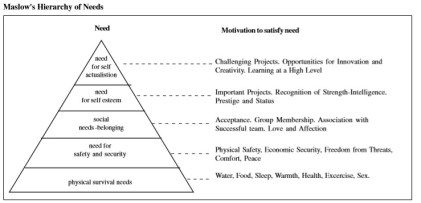
Maslow explains the basic hierarchy of needs that society requires in order to remain satisfied. At the bottom, he stays fairly basic with introducing the physical survival needs; water, food, sleep, warmth, health, exercise and sex. These are the basic things that humans need to survive.
Next is the need for safety and security, economically and physically. Furthermore, social needs were also added to the hierarchy, intending that we need acceptance, group membership, association with successful team, love and affection.
The next one up is need for self-esteem through important projects, recognition if strength and intelligence, prestige and status.
On the top of the hierarchy is the need for self-actualisation through challenging projects, opportunities for innovation and creativity and learning at a high level.
This specific theory shows me that my audience have a number of needs that need to be met in order to keep them satisfied. In this case, because our main idea for our documentary will be focused on social media and representation, we do not want to make our audience feel insecure with images that we might be portraying. We want to still ensure that they have a high self-esteem and accept themselves despite the topics we are talking about.
Cultural Effects Model:

These are the long-term effects of specific ideological representations on societies beliefs and values. For example, media’s representations if women gave been influential in giving both men and women a view of the ‘ideal women’ or ‘ideal man’.
With our documentary, we are aiming to debunk this by focusing on the topics of representation in the media and how men and women are portrayed versus the reality , in which the majority of men and women do not look like this.
Hypodermic Syringe Theory:

This refers to how audiences can be influenced by various media texts in a direct way. The analogy refers to how media text can inject ideas directly into the mid of an audience, who are usually passive. However, this theory has evolved over time into the two-step flow theory- which portrays that audience don’t actually get information through media texts but more often through opinion leaders who mediate information before selling it out to audiences. All media is produced by media producers, and therefore they take the role of the opinion leaders, whether it be directors, newspaper editors or TV personalities.
The Two-Step Flow Model (1994):
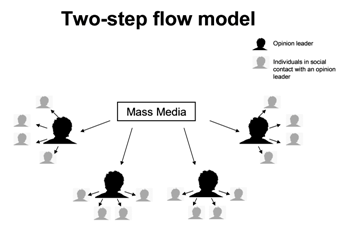
Paul Lazarfeld, Bernard Berelson, and Hazel Gaudet looked at the influence of media messages on voting intentions during a US Presidential election; information from the media moves in two ways:
Opinion leaders get information from a media source. Opinion leaders then pass the information on, along with their own interpretation, to others. The term ‘personal influence’ was coined to refer to the process intervening between the media’s direct message and the audience’s ultimate reaction to that message.
Overall, most people form an opinion under the influence of opinion leaders who are, in turn, influenced by the media.
In our case, we are once again discrediting this theory, by presenting that in fact, the audience are heavily influenced by the media, social media in particular. By scrolling through social media, you are forced to view images of models everyday, and this can very much influence an audience on how they want to present themselves to society.
On the contrary, we are also supporting this theory in a way because we are also going to be talking about certain viral social movements that social media circulate such as the #MeToo movement which campaigned for women who have been sexually assaulted, the #MarchForOurLives movement which supported the end of gun violence and the organisation of the march which shut down the majority of Washington DC. Therefore this supports the ‘opinion leader’ point of view.
Desensitisation Theory
Because audiences have consumed many forms of media in many mediums, the theory is that they have been desensitised to the connotations.
Violent and sexual content in media don’t have the same effect on audiences as they have already consumed so much of it.
This relates to the idea of conditioning, in which humans learn and develop by repetition. This is why when analysing past texts an analyst should always keep in mind the social and historical context.
We are debunking this theory by presenting the statement that looking at images of models on social media can actually make the social media users more insecure within themselves, which shows that it does actually make us more sensitive.
Uses and Gratification

Gratification is the pleasure gained by a satisfying desire. The Uses and Gratifications Model is a theory coined by Blumler and Katz (1970s). However, the theory has also been developed by various media theorists including Richard Dyer. This theory simply refers to how audiences can use the media to gratify various needs.
This theory suggests that people will actively seek out media products based on what they want to see. This theory means that the audience is active and its media use is goal oriented. McQuail, Blumler & Brown categorise the use of media to gratify needs into 4 types:
- The need to reinforce a view of personal identity by comparing our own roles and values with similar roles and values represented in the media.
- The need to have companionship and interaction with others – characters in the media take on the role of a ‘real’ friend or acquaintance
- The need to be informed
- The need for entertainment and diversion – escapism
In the past, people assumed that a certain meaning is encoded or placed in the text by the author and it is the job of the receiver/reader to decode the message and discover that meaning in order to share the author’s understanding of the world. But this is only one way to understand the process of watching a film. Another way is to adopt a more semiotic approach.
Semiotics is the study of signs. Importantly, because we all have different cultural experiences and we all perceive the world differently, any sign or communication text (like a film) can have many different meanings depending on who is looking at it– this is polysemy. Some texts are open and will invite multiple (different) readings and some are closed (trying to close off other readings in favour of the preferred meaning).
One of the early semioticians was a French philosopher called Roland Barthes who promoted the idea of ‘the death of the author’ – urging us to study ‘texts’ not authors because of the active process of ‘reading’ a text and the fact that everyone interprets texts differently. He also came up with 3 great terms – what he called the Order of Signification.
Denotation: The literal, obvious image (what it actually is)
Connotation: What we associate the image with in our minds (indirect and associative meaning)
Anchorage: The way that text (or parts of text) anchor particular meanings to images. In this way the creator of a communication text can steer the reader to the meaning that they prefer them to have
Stuart Hall’s Reading Strategies
For the audience theories based on audience passivity, the text is closed – the meaning cannot change. However, for Stuart Hall, the text is open to a range of different meanings – there is not just one way to read a text, but a multiple (polysemic) ways.
For Hall, the three ways to read a text are preferred (what he termed hegemonic), negotiated and oppositional readings:
Preferred or Dominant Reading:
The creator of a text (communication) may want it to be received in a certain way and so will construct it to ensure this happens – this could also be known as the dominant/hegemonic reading. You agree with the messages within the text.
Negotiated Reading:
An interpretation of the text in which, while identifying the dominant reading, you also seek to modulate this – you agree with some of the messages/messages.
Oppositional Reading:
Any reading which rejects or significantly challenges the dominant meaning. Under this model the reader is the key factor in the communication process and the production of meaning. Therefore, meaning is no longer singular and clearly demarcated or defined by authorial intention – meaning is not created by a God-like author.
Instead, meanings can change – meanings are plural and created through the relationship between the individual reader and the text.
Reception Theory
Reception theory implies that all media audiences are active, and that they never passively consume a media text. An audience is always making meaning from a text and this is based upon their education, ethics, culture etc. As such, every audience member takes a different meaning. Reception theory argues that no text has meaning by itself, but it is the relationship between the text and the audience that manifests the meaning.
We need to consider that different audiences and different audience members will read the media text in different ways. Not everyone will respond to a melodramatic “weepie” in the same way, nor will everyone find the same events emotionally shocking. However, it may well be that some filmmakers place certain meanings into the text through the ways that they construct it. But remember they do not have ultimate control over the ways in which the viewers will actually respond to the film.


