Documentary Questionnaire Analysis

Within this questionnaire, our group aimed to find out more about what people think of social media and how it influences others for our upcoming documentary.
q1

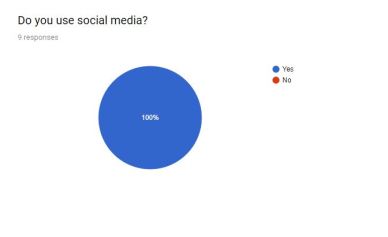
Firstly, within the first question, we wanted to know the rough estimate of people who use social media, and as it can clearly be seen, everyone who answered our questionnaire, used as least some form of social media, which therefore supports our statement that the majority of society uses social media. This means that our audience will be able to relate to our documentary.
q2

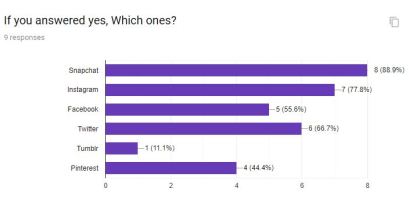
As it can be seen, Snapchat (88.9%) and Instagram (77.7%) are the most used social media platforms. Both of these platforms have something in common; the sharing of images. This shows how much image can influence an audience is this is what they look at for long enough. Another point to add to this is that this data also shows that everyone who answered this uses at least one of these apps. This will help with our documentary as it means that when it comes to planning interviews, the questions we ask will be comprehendible by the interviewees.
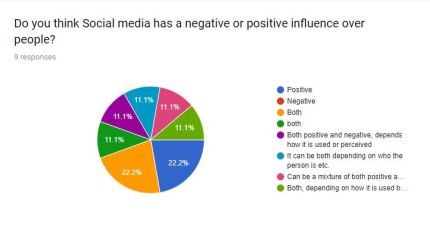
q3

This question showed that the majority of respondents believed that social media is mainly positive/ or a mixture of positive and negative. Seeing as we want to put social media in a more positive light, this data will support our statements as we can question people on why they might think that social media is positive and how the pros might outweigh the cons.- which will achieve our obvious aim of making a biased documentary.
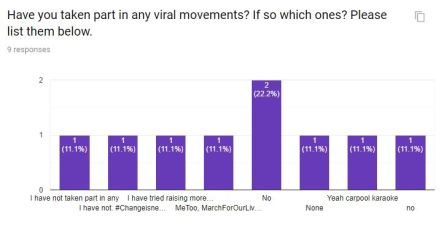
q4

When asking the audience about them taking apart of viral movements, we made this an open answer question so that they specify, but it seems that this gave invalid data due to the fact that not a lot of the respondents did not give set answered. Although they may have misunderstood the question by assuming that this meant actually going out to protests. However, we wanted to know if they had shared anything online to do with any viral movements. Luckily, in other questions, we asked more specifically in regards to these topics.
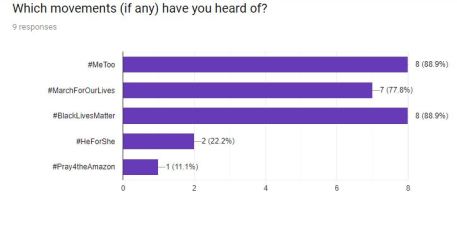
q5

 When asking the respondents about what movements they heard of, it was apparent they had heard of at least one of them. This reflects on social media’s power in regards to spreading awareness on extremely important issues, that might not be talked about enough in real life. These issues are will the key things that we want to cover in the documentary.
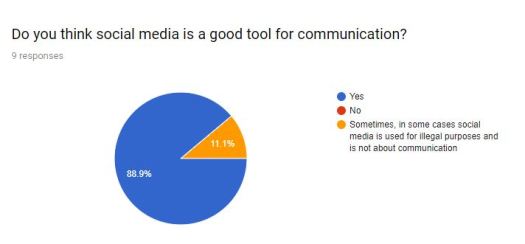
q7

Another positive impact of social media is its use for communication. Especially when it comes to staying contact with your loved ones who live further away or meeting people online.  The overall agreement that the audience with this statement was evident; with 89.9% saying ‘yes’ and no one saying no. Therefore, highlighting another benefit of using social media.
q9

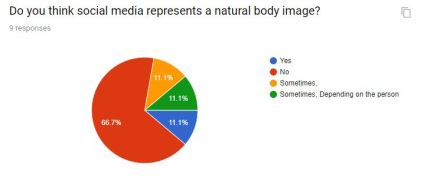
Now, moving onto the more negative aspects of social media, we started questioning the audience about body image on social media and if they think that what social media represents is real. As it can be clearly seen, 66.7% said no. This shows that it is known by the majority of society that images posted by models, news outlets, companies, etc. on these platforms, are not necessarily ‘real’. In our documentary, we want to know what people really think about this and how is makes them feel as individuals as this is another powerful effect that social media can have on people.
q8

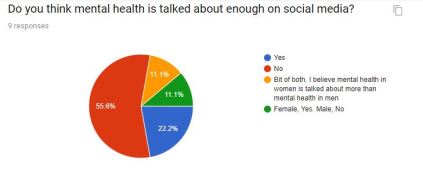
 Mental health is another topic that might not be talked about enough on social media, and the respondents agree as 55.6% answered ‘no’. We want to cover sensitive topics like this in our documentary due to the fact that people should discuss mental health more, especially in men, which could also be linked to toxic masculinity. Therefore, interviewing boys/men in this issue could also bring out information on why social media could’ve helped/not helped with their mental health.
q11

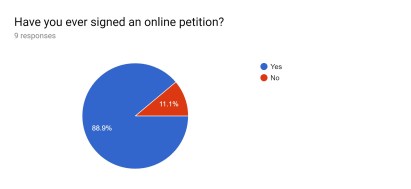
Online petitions are another big part of taking part in viral movements on social media and how these movements might reach out to people. Signing petitions can be as easy as entering your email and filling in your name on a form and you’re apart of the process for change. This is a way of taking part in something without having to go out of your way. And as it can be seen 88.9% of the respondents have actually taken apart in this. When creating our documentary, this would also be another interesting topic of discussion.
q10

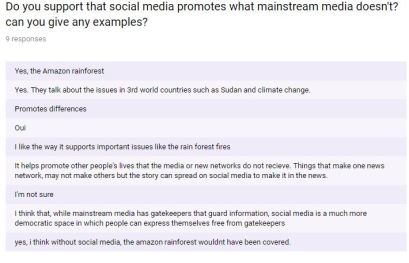
The answers from this question show that the majority support that social media is a more open and free space to discuss extremely important issues that the mainstream media did not or hardly covered. All of the respondents supported this, especially in regards to the Amazon Rainforest fires or climate change. Some suggested that social media is a more free, democratic place to spread information due to the fact that there are no gatekeepers that guard information.
q13

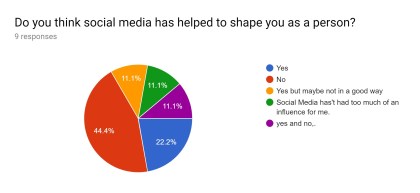
This was quite a broad question but the majority of respondents stated that social media has not influenced them as a person (44.4%), but 22.2% said that it has. This is an interesting topic to explore further in our documentary as social media can influence many people differently. It would be interesting to gather different viewpoints when discussing this topic.
q14

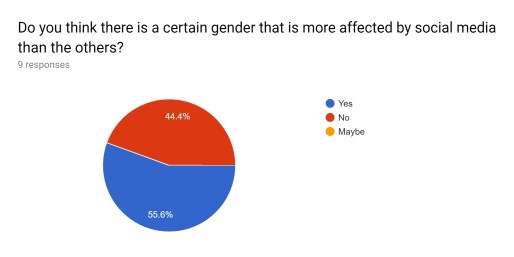
When we asked this question, the certain ‘gender’ we had in mind, would be women, due to most Instagram models being women, therefore making women/younger girls more conscious of their self-image. But of course, this would work in men’s case too, which is why the respondents answers are almost a 50/50 tie. This shows why we should also explore this topic further to see what both men and women think about this.
q15

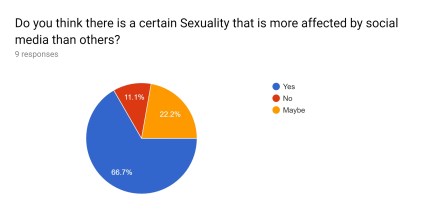
Asking a question about LGBTQ+ topics seemed important since social media has too, played a huge role in this community by bringing more people in the community together, in addition to people coming out and expressing their identities. The majority of respondents (66.7%) stated that asexuality IS more affected by social media than others. Because of this answer, this also proves to be an intriguing topic to discuss as this topic as whole, is another pointer in the direction of social media being positive. Would people rather use social media to promote change and better the world or would they rather stay off of it because it points out too many insecurities within themselves?
Types of Interviews.

Open Question- Questions that give opportunities for development = on an answer- the respondent can answer how they like with as much depth as they please making this qualitative research.

Closed Questions- This is a question that requires a short, definitive answer, with no deviation from the question whatsoever, this makes the data quantitative as it focuses more on the numbers of the answer.

Direct and Indirect Questions– direct questions relate to the subject matter with little to no

opportunity to digress. Whereas, indirect questions rely on the interviewee understanding what is really being asked.

Suggestive/ Leading/ Loaded Questions- Questions that imply the answer before it is asked.

Interview bias This is when the researcher asked questions that in a way which influences the respondents.

The Imposition Problem: The study may measure what the researcher feels is important but what the respondent may agree is important.

Demand Characteristics-  Researcher can potentially (and unconsciously) lead respondents (facial expressions etc.) This is known as demand characteristics- the interviewee’s responses being influenced by what he/ she feels the situation requires.

Structured Interview- where the interview is planned beforehand, meaning that questions going to be asked are fit in place and the interviewer will not deviate from the questions asked- very similar to a questionnaire.

  • The responses received are usually turned into quantitative data. The benefits of using this type of data is that it generates into a large amount of quantitative data which can be easily compared. However, the disadvantage is that the interview plays a passive role, meaning that they do not deviate from the questions are inflexible- they can’t really continue on any interesting leads.

Unstructured Interviews: This is also known as an informal interview in which there is no set questions and is more like a guided conversation, however, the interviewer still manages the interview but ensuring the topic of discussion is not completely deviated from. This type of research provides more in depth and insightful data- data with meaning. However, because the researcher gathers so much data and so the researcher has to be selective about what is published.

Semi-Structured Interviews: This is a mix of structured and unstructured interviews which usually contain closed questions in order to generate facts alongside with open questions. This allows the researcher some flexibility to ask for more clarification of vague answers.

Group Interviews: This involves the interviewer talking to a group or panel of respondents. This type of research is often used with children who may feel threatened if interviewed by an adult in a one-to-one situation.

Focus Groups: In this setting, participants are encouraged to talk to one another and discuss an issue rather than simply answering than answering set questions. The researcher relies more on the dynamic of the group top keep the discussion going- there is minimal interference from the researcher. The main issue, however, is that one personality might be more dominant than the other so the researcher might not necessarily get information on all of the participants.

Questionnaires: This is simply a list of questions, written down in advanced that are sent to the respondent for self-completion. Some questionnaires will use a combination of open and closed questions – this is known as semi-structured questionnaire. Semi-structured questionnaire come in two main forms:

  1. Self-Report – a type of questionnaire that lists a number of items of activities and asks respondents to tick those they have experienced

2. Attitudinal Surveys – usually asks respondents on a scale of 1-5 (strongly agree – strongly disagree).

Observation: This is when the researcher observes a subject in a particular situation. It can be done via two methods: Non-participant observation and Participant observation.

Non-participant observation: This usually involves the researcher observing an activity in an un-obstructive and detached manner. However, the subject’s behaviour could be un-natural with an “unusual” observer there

Participant observation: This involves the researcher immersing themselves in the lifestyle of the group he or she wishes to study. This type of observation can either be covert or overt.

Overt – the researcher joins in activities of a group and all or some of the group know that the researcher is observing them.

Covert – the researcher inserts themselves into a group and conceals the fact that they are doing research.

Graphs & Charts: When producing and presenting your research conclusions which analyse the data, it’s important that there be supporting visuals to summarise the information. By producing graphs and charts, data can be presented in a way that is simple to read and understand.

Audience Research

AUDIENCE RESEARCH

Preliminary Research: This is research undertaken before a project has begun. This means that the filmmaker will fully understand the themes of what they will be portraying in their work.  This includes things such as researching the market (what already exists), audiences’ feelings towards these products (consumer behaviour) and various other options the producers might want to consider in response to audiences’ reactions.

Post-Production Research: Sometimes the audience research is undertaken after the production in order to find out how well it might be received, and to make any changes before it is released to the public. This is often done with films to ensure that the audiences are going to like it, and can often make the difference between a happy and sad ending.

Primary Research: Research that is conducted by oneself- which is original research. This includes surveys, questionnaires, interviews, focus groups or own observation/ analysis.

Secondary Research: This is data that already exists that someone else has found, rather than one’s self. This is also known as a secondary source such as scholarship (books, articles) or statistics produced by charities, organisations or the government – any information that the researcher has found and brought together to support their analysis.

Theoretical Research: This is the use of research completed by others – their theories and ideas. It can include: reading books, articles, papers, watching documentaries, visiting websites etc.

Empirical Research: This is provable data – the use of observations or experiments to prove a theory.

Ethnographic Research: Ethnography means writing about the way of life, or culture of social groups. In terms of research, it usually features the researcher getting involved in the natural setting of the social group being studied, participating in and observing daily activities.

Quantitative Research: Getting an overview from a large number of people (quantity) – based on numbers and stats. It is the quantity of answers that is important and you want a lot of responses from a lot of people so you only desire short answers. For example, questionnaires, surveys, statistics, ratings, circulation figures, web-hits. Quantitative audience research would be gathering a large amount of varied data to make conclusions that answers questions such as ‘what’, ‘when’ and ‘where’. It includes such things as using data gathering agencies like BARB and RAJAR to generate an overview of information. The information will most likely not be detailed and specific, but it is a great starting point.

Qualitative Research: Getting in-depth, detailed information (quality) from a small number of individuals – it is the quality of the answer that is important so you will ask only a small number of questions and give the respondent time to give a detailed answer – interviews, observations, focus groups etc.

Qualitative audience research would be gathering a large amount of specific data to make conclusions that answers questions such as ‘how’, and ‘why’. This is usually done as a follow-up to quantitative audience research to determine how to act on the previous research. It includes such things.

Positivistic Research: This is a type of research that looks for patterns and trends (for generalisability). It is based on objective, numerical/statistical data (Quantitative Data). Research methods here might include: Use of official statistics; Questionnaires; Structured Interviews; and Structured Observations.

Interpretivist Research: This is based more on meanings and experience; subjective information (quantitative). Research methods here might include: Unstructured / Semi Structured Interviews; Open Questionnaires; Participant Observations; Content Analysis; Diaries; Ethnographic information.

Audience Theories

Audience Theories

Maslow’s Hierarchy of Needs:

MASLOW

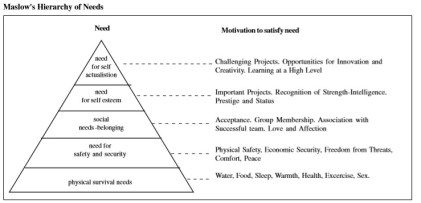
Maslow explains the basic hierarchy of needs that society requires in order to remain satisfied. At the bottom, he stays fairly basic with introducing the physical survival needs; water, food, sleep, warmth, health, exercise and sex. These are the basic things that humans need to survive.

Next is the need for safety and security, economically and physically. Furthermore, social needs were also added to the hierarchy, intending that we need acceptance, group membership, association with successful team, love and affection.

The next one up is need for self-esteem through important projects, recognition if strength and intelligence, prestige and status.

On the top of the hierarchy is the need for self-actualisation through challenging projects, opportunities for innovation and creativity and learning at a high level.

This specific theory shows me that my audience have a number of needs that need to be met in order to keep them satisfied. In this case, because our main idea for our documentary will be focused on social media and representation, we do not want to make our audience feel insecure with images that we might be portraying. We want to still ensure that they have a high self-esteem and accept themselves despite the topics we are talking about. 

Cultural Effects Model:

Image result for baby watching tv

These are the long-term effects of specific ideological representations on societies beliefs and values. For example, media’s representations if women gave been influential in giving both men and women a view of the ‘ideal women’ or ‘ideal man’.

With our documentary, we are aiming to debunk this by focusing on the topics of representation in the media and how men and women are portrayed versus the reality , in which the majority of men and women do not look like this.  

Hypodermic Syringe Theory:

Image result for hypodermic syringe theory

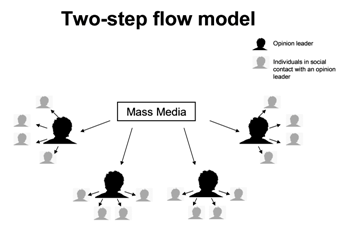
This refers to how audiences can be influenced by various media texts in a direct way. The analogy refers to how media text can inject ideas directly into the mid of an audience, who are usually passive. However, this theory has evolved over time into the two-step flow theory- which portrays that audience don’t actually get information through media texts but more often through opinion leaders who mediate information before selling it out to audiences. All media is produced by media producers, and therefore they take the role of the opinion leaders, whether it be directors, newspaper editors or TV personalities. 

The Two-Step Flow Model (1994):

TWO STEP MODEL

Paul Lazarfeld, Bernard Berelson, and Hazel Gaudet looked at the influence of media messages on voting intentions during a US Presidential election; information from the media moves in two ways:

Opinion leaders get information from a media source. Opinion leaders then pass the information on, along with their own interpretation, to others. The term ‘personal influence’ was coined to refer to the process intervening between the media’s direct message and the audience’s ultimate reaction to that message.

Overall, most people form an opinion under the influence of opinion leaders who are, in turn, influenced by the media.

In our case, we are once again discrediting this theory, by presenting that in fact, the audience are heavily influenced by the media, social media in particular. By scrolling through social media, you are forced to view images of models everyday, and this can very much influence an audience on how they want to present themselves to society. 

On the contrary, we are also supporting this theory in a way because we are also going to be talking about certain viral social movements that social media circulate such as the #MeToo movement which campaigned for women who have been sexually assaulted, the #MarchForOurLives movement which supported the end of gun violence and the organisation of the march which shut down the majority of Washington DC.  Therefore this supports the ‘opinion leader’ point of view.

Desensitisation Theory

Image result for desensitisation theory

Because audiences have consumed many forms of media in many mediums, the theory is that they have been desensitised to the connotations.

Violent and sexual content in media don’t have the same effect on audiences as they have already consumed so much of it.

This relates to the idea of conditioning, in which humans learn and develop by repetition. This is why when analysing past texts an analyst should always keep in mind the social and historical context.

We are debunking this theory  by presenting the statement that looking at images of models on social media can actually make the social media users more insecure within themselves, which shows that it does actually make us more sensitive.

Uses and Gratification

Image result for uses and gratification theory

Gratification is the pleasure gained by a satisfying desire. The Uses and Gratifications Model is a theory coined by Blumler and Katz (1970s). However, the theory has also been developed by various media theorists including Richard Dyer. This theory simply refers to how audiences can use the media to gratify various needs.

This theory suggests that people will actively seek out media products based on what they want to see. This theory means that the audience is active and its media use is goal oriented. McQuail, Blumler & Brown categorise the use of media to gratify needs into 4 types:

  • The need to reinforce a view of personal identity by comparing our own roles and values with similar roles and values represented in the media.
  • The need to have companionship and interaction with others – characters in the media take on the role of a ‘real’ friend or acquaintance
  • The need to be informed
  • The need for entertainment and diversion – escapism

In the past, people assumed that a certain meaning is encoded or placed in the text by the author and it is the job of the receiver/reader to decode the message and discover that meaning in order to share the author’s understanding of the world. But this is only one way to understand the process of watching a film. Another way is to adopt a more semiotic approach.

Semiotics is the study of signs. Importantly, because we all have different cultural experiences and we all perceive the world differently, any sign or communication text (like a film) can have many different meanings depending on who is looking at it– this is polysemy. Some texts are open and will invite multiple (different) readings and some are closed (trying to close off other readings in favour of the preferred meaning).

One of the early semioticians was a French philosopher called Roland Barthes who promoted the idea of ‘the death of the author’ – urging us to study ‘texts’ not authors because of the active process of ‘reading’ a text and the fact that everyone interprets texts differently. He also came up with 3 great terms – what he called the Order of Signification.

Denotation: The literal, obvious image (what it actually is)

Connotation: What we associate the image with in our minds (indirect and associative meaning)

Anchorage: The way that text (or parts of text) anchor particular meanings to images. In this way the creator of a communication text can steer the reader to the meaning that they prefer them to have

 Stuart Hall’s Reading Strategies

For the audience theories based on audience passivity, the text is closed – the meaning cannot change. However, for Stuart Hall, the text is open to a range of different meanings – there is not just one way to read a text, but a multiple (polysemic) ways.

For Hall, the three ways to read a text are preferred (what he termed hegemonic), negotiated and oppositional readings:

Preferred or Dominant Reading:      

The creator of a text (communication) may want it to be received in a certain way and so will construct it to ensure this happens – this could also be known as the dominant/hegemonic reading. You agree with the messages within the text.

Negotiated Reading:

An interpretation of the text in which, while identifying the dominant reading, you also seek to modulate this – you agree with some of the messages/messages.

Oppositional Reading:          

Any reading which rejects or significantly challenges the dominant meaning. Under this model the reader is the key factor in the communication process and the production of meaning.  Therefore, meaning is no longer singular and clearly demarcated or defined by authorial intention – meaning is not created by a God-like author.

Instead, meanings can change – meanings are plural and created through the relationship between the individual reader and the text.

Reception Theory

Reception theory implies that all media audiences are active, and that they never passively consume a media text. An audience is always making meaning from a text and this is based upon their education, ethics, culture etc. As such, every audience member takes a different meaning. Reception theory argues that no text has meaning by itself, but it is the relationship between the text and the audience that manifests the meaning.

We need to consider that different audiences and different audience members will read the media text in different ways. Not everyone will respond to a melodramatic “weepie” in the same way, nor will everyone find the same events emotionally shocking. However, it may well be that some filmmakers place certain meanings into the text through the ways that they construct it. But remember they do not have ultimate control over the ways in which the viewers will actually respond to the film.

Audience Types

Audience Types:

Image result for audience types

Primary audience- the audience is mainly being targeted for those you receive the film directly, the audience that the filmmaker is aiming for, whereas the secondary audience is focused more of the ‘hidden’ audience members, which are the audience that the filmmaker does not know and they might’ve received the film through a link from someone else- not the audience you might’ve particularly aimed your film at initially.

Demographic and Psychographic Profiling:

Image result for demographic

Demographics refer to:

  • Age
  • Gender
  • Race& Ethnicity
  • Sexuality
  • Class and Status

The age we are aiming will mainly be a younger audience, the people who are on social media and talk about it everyday, however, within gender, race, ethnicity, sexuality, class and status, we are not aiming for any specifics within these categories as we want to reach as wide of an audience as possible. 

The NRS Social Grades Divides Audiences into groups based on their social class or socio-economic status:

  • A: Upper Middle Class. Higher managerial, administrative or professional
  • B: Middle Class. Intermediate managerial, administrative or professional
  • C1: Lower Middle Class. Supervisory or clerical and junior managerial, administrative or professional
  • C2: Skilled Working Class. Skilled manual workers
  • D: Working Class. Semi and unskilled manual workers
  • E: Economically Inactive. Pensioners, students, unemployed. Very low-grade workers.

Within our documentary, we are mainly producing our product for people who use social media frequently, therefore people who have access to to electronic devices, therefore we are aiming for at least C2 and up within social class.

Psychographic Profiling:

Image result for psychographic profiling

Psychographic profiling targets audiences using psychological rather than demographic characteristics.

  • Resigned – Rigid, strict, authoritarian and chauvinist values, oriented to the past and to resigned roles. Brand choices stress safety, familiarity, economy. (Older).
  • Struggler – Alienated, disorganised. Heavy consumers of alcohol, junk food and lotteries, also trainers. Brand choice involves impact and sensation.
  • Mainstream – Domestic, conformist, conventional, sentimental, passive. Part of the mass, favouring big and well-known brands.
  • Aspirer- Materialistic, acquisitive, image, appearance, charisma, persona and fashion (Younger, clerical/sales type occupation).
  • Succeeder- strong goal orientated, confidence, work ethic, organisation … support status quo, stability. Brand choice based on ethics, reward, prestige.
  • Explorer – Energy – autonomy, experience, challenge, new frontiers. Brand choice highlights difference, sensation, adventure, indulgence and instant effect (Younger – student).
  • Reformer – Freedom from restriction, personal growth, social awareness, independent, tolerant, anti-materialistic but intolerant of bad taste. Curious and enquiring. Select brands for intrinsic quality, favouring natural simplicity, small is beautiful. (Higher education).

Within psychographic profiling, we are mainly aiming for the mainstream audience, as they are apart of the mass audience; the people who use social media.  Furthermore, the struggler is also someone who might show interest in this documentary, mainly with this documentary we want to boost the audience’s self- esteem and leave them with wanting a better view of themselves.

Geographics

Categorising based upon where people or have been brought up:

  • National identity
  • Regional identity

Stereotypes

A commonly held belief or different social groups, based upon prior assumptions:

  • Actions and behaviours
  • Aesthetics
  • Thoughts and emotions

Ensure that people are represented fairly and unbiased.