Reel Talk- Evaluation

Throughout the production of Reel Talk, there was a great deal of planning and idea generating to get an idea that we were actually confident to go through with. After a while of thinking what our show could be, we decided on it being based around Film and TV as this is what we found to be more interesting

There were many pros throughout this project. Firstly, as my role of production manager, I feel that I was effective by getting our group to communicate to generate their thoughts on what we should include in our show. By setting a ‘WhatsApp’ group chat, we managed to talk to each other easily which got thing done sooner. This chat helped with not only pre-production, but during production too because while some crew members were in the studio planning and wanted other crew members to see it, they would just post a message in our chat, proving it be extremely helpful.

Overall, the class or the “crew” worked very effectively together as we all stuck to our roles and getting specific things done with those roles. For example, the camera operators all stuck to creating shot lists and floor plans, the set designers created mood-boards and floor plans of the studio to show where all the props will go, the lighting crew were in the studio often, experimenting with different lighting tones and colours and they reported back to all of us often, and so on. Personally, I stuck to the pre-production such as the risk assessment and location reconnaissance whereas the floor manager of the show, who I worked closely with throughout the project, created the call sheet and production schedule. By working like this, we had pre-production work done sooner than expected.

However there were times during the planning stage that some ideas got changed around and in the end, there were quite a few aspects of the show that was different to the original plot we had planned. For example we struggled coming with ideas for the VTs and plans changed a lot for those. For example, our VT titled, In The Spotlight, was originally going to be based on three Mexican directors, for this VT, we were going to film one of our teachers reading information about them and use her voiceover over a montage of their clips from the movies, pictures of them, etc. However we decided to change this over completely to an interview with a Film and Television lecturer from Solent University about the impact of streaming platforms and services on broadcasted television. I was in the group to create this VT and we had to write approximately 10 questions for him to answer. Overall, this VT proved being a lot more effective than the previous one that was going to be filmed due it being easier and it seemed very professional in addition to it suiting our show more. Another VT we struggled with was the Reel List, which was originally going to have a presenter counting down the best movies and TV shows, however we recorded this whole segment and found out that the audio was not working, therefore we just decided to re-record the audio and just use a voiceover and compile videos and images and create a montage with a voiceover. However, luckily these changes were for the best instead of the opposite as it all worked out smoothly.

Another issue that I would’ve wanted to change would be getting the script to the hosts sooner, as we only got it to them 2 days before the show instead of getting it to them at least 4 days before. Despite our hosts being very compatible in addition to them comprehending the idea of the show, they did read a lot from the script on the day of filming, meaning that it looked somewhat unprofessional, however it was best for them to know what to say instead of them getting lines wrong or forgetting what they have to say, etc.

However, overall, the production of Reel Talk went very well due to the fact that everyone carried out their roles on the day making the day a great deal less stressful due to the fact that we all stuck to our own roles, however we still helped each other where need be, making the show a success

In regards to my own work, I believe that I stuck to my role well, I mainly focussed on the logistics on the show and ensured that everything came together the way we wanted/ planned. I did my job by sourcing the props we needed, getting the crew together, meeting the hosts and explaining to them what the show is going to be set on, working on the pre-production, directing a VT and overall ensuring the show was going to according to plan. However I do think I could’ve been more effective when filming but the floor manager had everything going to plan.

My peers stated that they thought I was effective as a production manager and fulfilled my role by being organised and ready to fix any issues that we had.
Social Media Updates

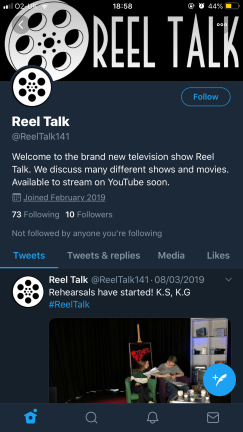
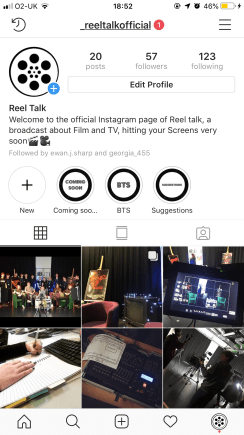
Throughout the production of Reel Talk, all the crew ensured to update our social media accounts everyday. We would alternate days when a group of us would post and keep the audience entertained and intrigued.

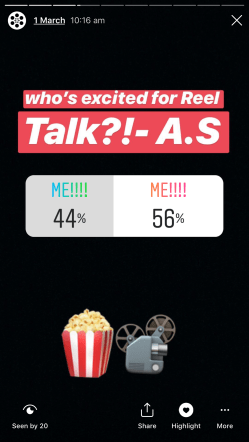
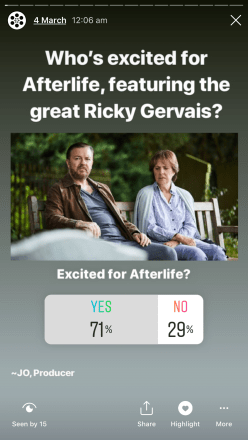
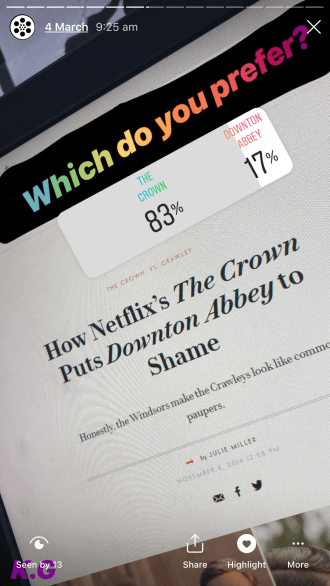
First week of production: On Instagram, we mainly put a lot on our “stories” in order to keep everything updated. For example we would put behind the scenes pictures of set design or the filming of some VTs in the studio in addition to things such as our pre-production work. We also used polls on our stories to ask the audience questions such as what shows the prefer, if they prefer one show to another. To keep them feeling excited, we created a countdown that we used everyday. Our Twitter consisted of very similar content. On this we also would tweet updates about our show and behind the scenes pictures.

Second week of production: In the second week of production, we still stuck to a strict schedule as to who was posting what and we ensured to keep updated as this week was the major week when most of the planning was occurring and everything was being finalised. For example, a lot of people went out to film their VTs including myself and a small group who went to Solent University to interview a lecturer. Therefore the next day while we were editing footage, I took a picture of it and put it on our story to show our audiences where we had been. Furthermore, throughout the week we just kept posting our countdown and sneak peaks/ behind the scenes posts to showcase our pre-production process. On the day of production, we still updated our social media by posting the preparation, the hosts getting ready in hair and makeup, and then finally the hosts on set. After we finished filming, we posted on our social media’s that we had wrapped.

Third week of production: This week we have mainly been focused on editing, therefore, our social media followers have been getting updates on our editing process, getting them ready for when the show will finally be up on YouTube.

This video will help give you an insight into what our social media updates were like and what they consisted of:

https://youtu.be/OudoLnvsrnk  

Production Diary- Reel Talk- 22/03/19

Friday 22nd March.

After 3 days of editing, I exported my final edit of Reel Talk today.

Unexpectedly, the show was quite easy to edit after properly getting into it. I assumed because of the lagging throughout editing that this it would be a much longer process, however that was not the case. Although the footage was still slightly behind the audio, I just mainly followed the audio of the clips and made my cuts that way and it work out quite well.

As for the VTs, I added them in as I went along because I found that it would be easier this way instead of adding them in at the end and trying to separate the takes to the timings of the VT.

I did have some trouble editing take 5 though as I notice it was not transferring one of the hosts audio to the take, which made her audio a bit quieter however, I managed to fix this issue in the end. Other than this I didn’t experience any other problems while editing

To finish everything off, I added in all the graphics which were created by our graphics designer for the show. For example, the name tags for our hosts and guests, the transitions and the Reel Oscar winning movie titles.

Additionally I added in some royalty free music for the Reel Oscars to add more effect to it and that was about it.

After finalising everything I went to export the video, once it finished, I uploaded it onto YouTube.

Production Diary 7- 13/03/19 Live Editing Masterclass

Now that we have finished the show, it was time to start editing.

In order to edit in a proper live editing fashion, on of our lecturers, Freddie’s showed us the steps of live editing.

Firstly, before opening premiere software, we had to label all of the footage and audio into the correct order and put it all in individual folders, for example the Take 1 roll folder had all of its footage and audio in one folder together and each one was labelled something along the lines of “Callie’s audio – take 1” or “Master Camera take 1”.

After doing this, we had to open Adobe Premiere Pro and import the folder which had all of the footage and audio in it, this took a while due to the larger folder size but once it was all uploaded, Freddie began explain what the we had to do for editing.

He first told us to click the arrows on each of the “take” folders so that we could see all of the footage and audio in them. Then pressing down the “CTRL” we had to select all of the take 1’s from each folder, once we had done this, we had to right click and select “create multi camera sequence” and the software matched the frequencies of the camera audio to the up with the microphone audio and creating a sequence all in go. Then to edit the clips and make cuts, we had to use the multi camera toggle to choose which angle/ shot we want to use, when you click the cut you want to use, it automatically cuts it for you.

This is how I intend to edit each cut throughout the editing process.

In regards to editing progress today, I managed to finished editing the first take. It took a while for all all of the footage and audio to transfer over to Premiere Pro due to its large size in addition to everyone else in the class editing the same footage hence why I only managed to finish editing the first take. Additionally while editing, it took a while to do so because the footage was lagging quite a bit, making it difficult to make accurate cuts. However, next lesson, the footage should flow more smoothly due to some of the class downloading the footage onto their personal memory sticks. Therefore, I plan on starting on take 2 as soon as possible.

Issues Relating to Factual Programming

5 Core Values of Journalism

Accuracy: the truth can be replaced by accuracy, meaning that all facts stated are precise and correct, it is unethical for the journalist to portray information that is incorrect just to support a point trying to be made.

  • “No deceptive handling of the facts.”- Aiden White- Director of Ethical Journalism Network.

Independence: When one becomes a journalist, they become the soul responsible of the words written, verbal, or any information that that they  broadcast.

  • “When transmitting information, you become an independent individual.”-Aiden White- Director of Ethical Journalism Network.

Impartiality– A journalist has to ensure that there is more than one version of the story being told, therefore this has to be recognised to avoid the story being completely bias.

  • “Looking and thinking what are the other sides of this story”- Aiden White- Director of Ethical Journalism Network.
  • “Impartiality will help bring the story as a whole”- Aiden White- Director of Ethical Journalism Network.

Question of Humanity– There are always consequences to your words and actions, therefore, the way one communicates must be done with caution as these words could cause harm to certain people reading the article. For example, any type of hate speech or graphic media shown (however it does depend on the context of the article, graphic media might be justified).

  • “Expected to be aware of the consequences of what you publish and what you broadcast”- Aiden White- Director of Ethical Journalism Network.
  • “Journalism should be part of a humanitarian process”- Aiden White- Director of Ethical Journalism Network.

Accountability-  the fact or condition of being responsible for one’s own actions.

  • “Engage with audience and correct our mistakes”- Aiden White- Director of Ethical Journalism Network.

For example, the case of Chelsea Manning, a transgender woman, who prior to her transition, served in the US military as an intelligence analyst. She had access to classified databases and later on, leaked this information to Wiki Leaks. Her story was followed heavily by the media, however, they tended to focus on the fact that she was transgender and brought up negative information on her part, however journalists (who clearly support the governments privacy) writing this story  did not support the fact that she leaked this information and seemed to to take it more personally. The majority of the articles being written about her failed to recognised both sides of the story and often picked up on the fact she was transgender, when in reality, this fact was completely irrelevant to the story.

Creative Roles in the Creative Media Industry:

⁃ Director

⁃ Screenwriter

⁃ Photographer

⁃ Casting director

⁃ Colourist

⁃ Composer

Technical

⁃ Editor

⁃ Sound technician

⁃ Director of photography

⁃ Lighting technician/ spark

⁃ Make-up artist

⁃ Camera operator

Editorial

⁃ Accountant

⁃ Script doctor

⁃ Magazine editor

Marketing

⁃ Content marketer

⁃ Copywriter

⁃ Distributed

⁃ Advertiser

Managerial

⁃ Producer

⁃ Executive producer

⁃ Assistant director

⁃ Studio head

⁃ Project manager

Administrative & Research

⁃ Location scout

⁃ Researcher

⁃ Personal assistant

Roles and Responsibilities in Live TV:

Producer/ News Editor

⁃ the producer initiates coordinates and supervised and controls matter such as raising funding, hiring key personnel, legal, administrative, technological and artistic aspects of a production. The producer is involved throughout all phases of the process from the development to completion of a project ensuring the production always stays on time for deliver.

Director

– The director is responsible for all CREATIVE aspects of a production. The director typically helps hire the cast. The director helps decide on locations and creates a shooting plan (shot list). During shooting, the director supervises the overall project, manages shots.

Production Manager

The production manager makes deals concerned with business about the cast and crew. Creating call sheets, production schedules, budget sheets, ensuring all cost and crew in time, organises the technical needs of the crew and cast.

Floor Manager

Represents the director on the studio floor and gives instructions and directions to the crew, cast and guests. The floor manager also checks that the floor is clear and safe for the performance and makes announcements to the staff and audience. Helps maintain in the quietness and order calls cues and prompts talents as required.

Camera Operator

Uses the camera as instructed by the director to desk and compose the shots. They ensure the required action is correctly filmed in the frame. And must react instinctively as the proceedings take place.

Sound Tech

Weill oversee the audio aspects of the production. During shooting sound operators will maintain good clean audio recording levels placing microphones on cast sound checking ensuring enough battery listening closely to action and adjusting accordingly.

Lighting Tech

Involved with setting up and controlling lighting equipment. Safely lighting the set, selecting the appropriate types of lights colours for the scene and will often lights on and off from the prompt of the director.

Script Supervisor

Oversee the continuity of the production including wardrobe props hair and makeup actions during the scene. Notes will be recorded during the production help the editor.

Set Designer

Collars with the directions and other members of the prod design team to control productions onscreen appearance including sourcing props and materials.

Graphics Designer

Designs what graphic content is displayed on air.

SOLENT UNIVERSITY VISIT- 15/03/19

Today at Solent University, we were invited to watch a live show by the third year students being made. This show was a game show called ‘Walk the Block’ in which there are two teams (red and blue) and one teammates from each team has to stand on their side of a catwalk and the host of the show has to ask the other teammate a question, and if they get it right, the team member on the catwalk can move forward the game goes on this way until the winning member is at the end of the catwalk. During the rehearsal of the show, our class members could choose who they wanted to shadow from the crew. For example, on of the camera operators, lighting, sound, graphics, floor manager, live editing, etc. I chose to shadow a camera operator, she was working on the main camera located in the middle of the set. I got into a discussion with her about university and how I was unsure if I wanted to go or not. She told me that she was in a similar situation to me and decided last minute that she wanted to attend university. She also told me about the course what she does and has been doing for the past 3 years of being at uni. Furthermore, she proceeded to show me how she works the camera and once the rehearsal started I watched her operate the camera. This definitely gave me more of an insight as to what it is like to work in that kind of environment. You have to stay very focused and heads on in this kind of job.

After we watched the rehearsals and took a quick break, we watched the actual live show being filmed. This time we sat in the audience while watching it being done and took part in the game on our phones by answering questions on their website. After we watched the successful run through of the show, we were told the show was going to be done again, but our class was going to take their roles. I and a few other people went up to a control room where mainly the managerial team go such as the producer, director, etc. I decided to work with the graphics by playing the VTS for the show. It actually took a lot of concentration as I had to pay attention to the directors cues

Overall this was a very educational experience and I’ve definitely learnt a lot more about live shows and what goes into them.

Social Media Strategies

In regards to what the live show will be doing on social media, we have decided to create a twitter and an Instagram which will be updating throughout the pre-production, production and post production.

On Instagram, we are mainly going to be posting pictures of the pre-production work we are going to give the followers a bit of insight to our work before the show comes out. This will give them an idea of what to expect and will also hopefully get them intrigued as to what will be on the show. We will also run polls on both twitter and Instagram to see if people prefer originals and remakes, what shows and movies they are currently watching, what they are looking forward to, etc. We hope to achieve a lot of feedback from the our audience to help us prepare.

UPDATE- After the show:

Using social media proved to be very useful as we kept on top of it and ended up getting many followers on Instagram, meaning that we could reach a wider audience.

Posts in which we asked people questions got many replies, and this was the same with the polls, many people answered our questions meaning that we could use this information on the show, making it seem more professional.

Although our twitter was not as successful as our Instagram, we kept it up to date and tried our best to interact with followers on there.

PICTURES OF ACCOUNTS AND ACTIVITY:

My Roles and Responsibilities

For our live show, I have chosen to be a production manager. This means that I have to focus on the logistics of show and what is going to need to go into it. For example I will be doing things such as the risk assessment, which means I will be identifying all of the possible hazards that could take place and what will need to be in place if any of these accidents do actually occur. I will also be completely location information forms, meaning that I will find all of the information on the possible places that we will be filming at what possible limitations there would be from filming there and what can be done to prevent the problems. Furthermore I would have to be sourcing everything for the show such as props, hosts, video clips, etc In addition to this I will have to be making call sheets which is similar to a schedule as it contains the people needed and what times they will be needed on the day. On the day of the show I will be working with the floor manager to ensure that everything is going to plan with the timings of everything and ensuring that the guests on the show are sticking to the script and everything planned out for them.

Overall, I need to ensure that everything goes according to plan and ensure there are no problems with the show and if there are, they need to fixed and kept under control.